“Pomme” - Apple
I’ve been a bit humbled by Superior. In my last terms, I was quick—often finishing among the first five in the class. In this group, I’m much closer to the middle and occasionally the back of the pack. My grades are still good—very good, even. But I’m feeling…something. My age, maybe? Speed isn’t everything, but it certainly helps.
If I have a weak spot, it’s probably (and unfortunately) sauces. Again, all of my sauces are perfectly fine. It’s just that my sauce is always what Chef comments on most. I have a list of comments I’m compiling for how to improve my saucemaking.
I make a jus and it’s either too fatty or too liquid. How do you solve this? Remove fat by starting with less fat to begin with, de-fatting your trimmings once they’re brown, or spooning it out as it cooks. All are fine options, but the last one can be painstaking. And if you’ve already gotten that far, it’s going to be a pain. French cooking is reduction, because reduction means concentration. Just recently, a jus I made was too thin—it was the one thing that prevented me from my first perfect score on a dish. I worry about over-reducing because you’re left with so little jus that it barely feels worth the effort. Chef suggested I just crank the temperature right at the end to give the jus a brief boil. That’s about all it takes to thicken it up.
Another comment is that my sauces lack a certain flavorful punch. Like a champagne sauce I made in intermediate, or a beurre nantais just recently. In both situations, Chef suggested that when you make a sauce with a liquid (champagne for the first example, vinegar for the second) that adding just a little extra splash of that liquid after all the reduction and straining and finishing can help pronounce that flavor.
I expect all of you reading at home to make expert-level sauces with those tips.
Our first atelier (or “workshop”) was today. We were asked to complete two plates each of both an entree and a plat, both of our own design with certain mandatory ingredients. For my entree, I made a cannelloni of zucchini stuffed with a salad of lobster on a cracker of phyllo pastry. It sounds simple but it was remarkably time consuming. I wrote and followed this recipe: made a court bouillon to cook the lobster; cooked the lobster; made a mayonnaise for the lobster salad; made a vinaigrette for the fennel salad; made the phyllo crackers by painting butter between the sheets of phyllo, cutting them into rounds, and baking them; broke down the lobster; sliced the zucchini on a mandoline into thin strips, then sweated in olive oil, and rolled them into a cylindrical shape; sliced the fennel on a mandoline and dressed it in the vinaigrette; julienned (cut into thin strips) both apple and fennel and quick-pickled them in sugar and vinegar; brunoised (cut into 2x2x2mm cubes) both apple and ginger; mixed the lobster salad together, and plated.
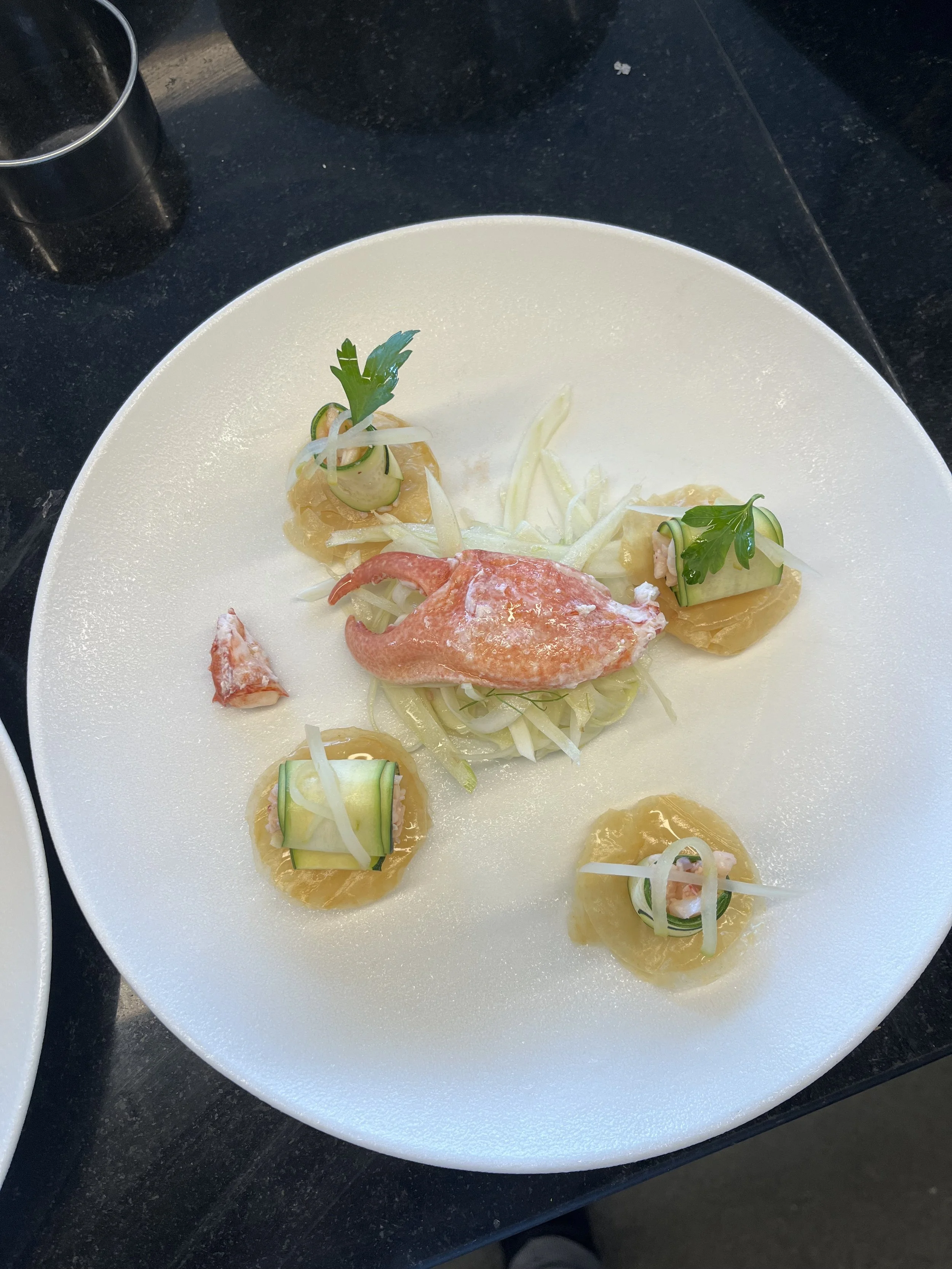
See? It’s more than it seems. Probably too many touches for an entree. Especially when you consider we also had to plate two plats as well. My devised dish was a chicken ballotine (think meat pounded flat, filled with a stuffing, and rolled into a tube) stuffed with a farce of chicken breast, mushroom, and cabbage, served with foie gras, chutney, jus, and purée of yellow carrots.
For that it required me to: break down an entire chicken (remember, they land on our boards with heads, feet, and the majority of their guts still attached), filet the breast, and debone both cuisses, which is both the leg and thigh together; make a jus by browning the spare chicken trimmings, adding water and reducing multiple times; finely chopping the chicken breast, mushrooms, and cabbage before cooking individually and then combining into a “forcemeat,” stuffing the deboned cuisses with the forcemeat, rolling them tightly, and cooking them in a steam oven; boiling the carrots until very well done and forcing them through a sieve to “purée” them; chopping apple and carrot into a brunoise and making a chutney; browning a slab of foie gras and cutting 2cm circles from it for plating; searing and crisping the cooked ballotine in butter; then plating it all.
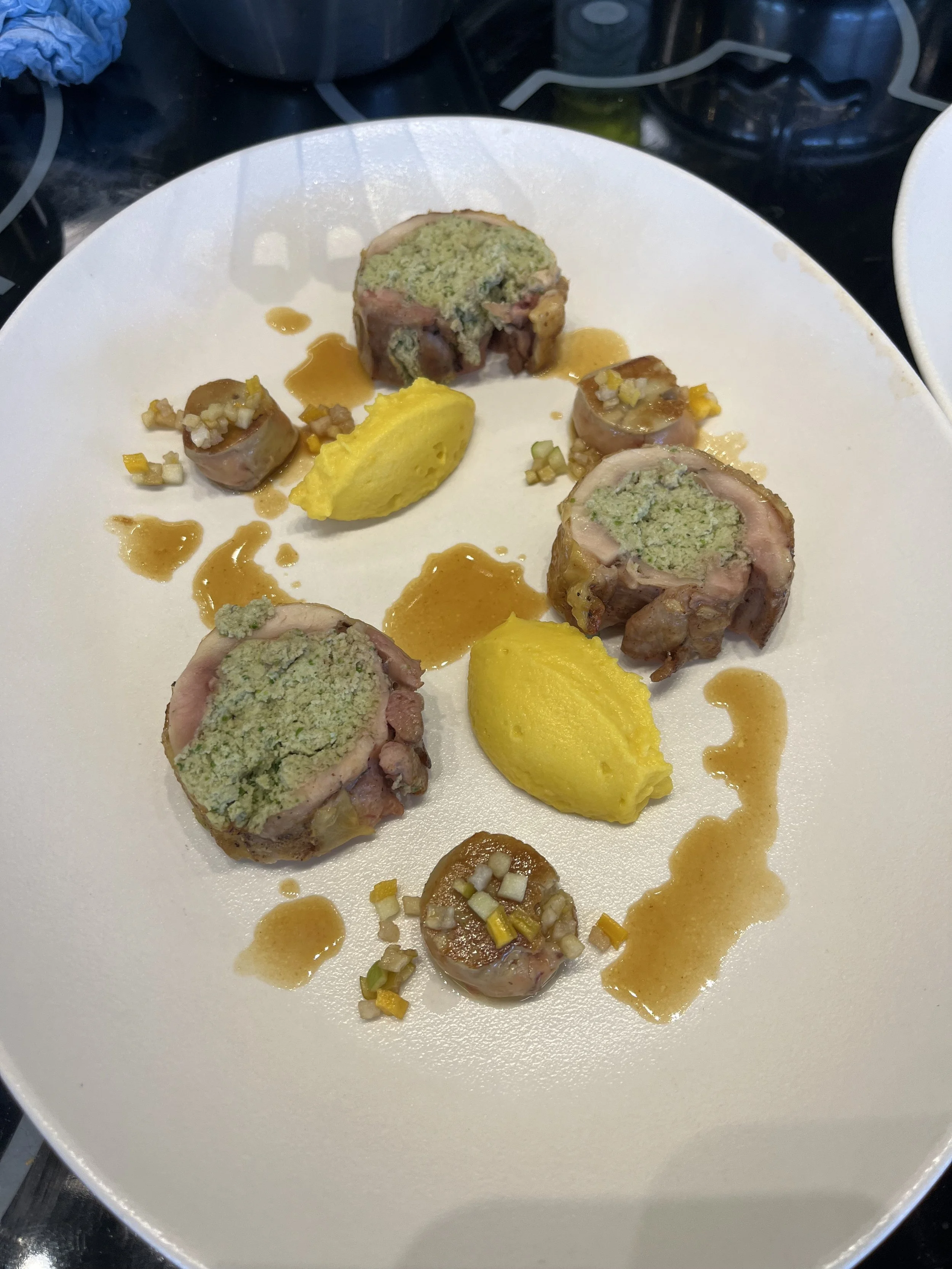
Overall, chef was complimentary and had suggestions for improvement (everything you want in a teacher). The one hit was that my stuffing of the ballotine was “not good.” It ended up very dry. Fortunately, I know what I did wrong. I cooked the chicken of the farce before I stuffed it into the thigh, wrapped the ballotine and cooked it in a steam oven. Instead, I should have left the chicken raw, mixed it with the thoroughly cooked mushroom duxelles and cabbage, then steamed it until done. My jus, however, was “good, very good.”
Katy has asked that I grow a mustache. She tells me that in combination with my long-ish hair, clothes, and sandals, it’s “a vibe,” though I’m fairly certain it’s because she’s seen pictures of Harry Styles with one. Listen, I’m pretty good at a handful of things, but this is not one of them. At nearly 40 years old, my facial hair still grows at the density and scarcity of a 14 year old. In fact, there may be 14-year-olds who have better facial hair than I do. My father had a full, thick beard and mustache consistently from my birth and probably before that. Those genetics, of all things, didn’t pass along to me. But I’m trying. While I waited outside of a classroom for a practical cook recently, one of our chefs walked by. He fist-bumped me and then half-smiled. He drew his fingers across his upper lip and raised his eyebrows. “Je sais, je sais. Mais ma femme, elle aime ça.” (“I know, I know. But my wife, she likes it.”) He smirked and shrugged and said, “Ah, pour l’amour. Bien sur.”
Auggie is, inexplicably, a little boy now. Nearly none of his clothes fit even though Katy smartly packed a wide variety including those which were much too large for him when we left on this adventure, including shoes. Katy bought him a pair of knockoff Crocs and he calls them his “work shoes,” because they look similar to my kitchen shoes. (For what it’s worth, I wear Danskos. But don’t tell Auggie that.)
Recently we took him to the Musée des Transports Urbains de France (Museum of Urban Transportation of France). It’s a little museum in the Parisian suburb of Chelles. It’s only open twice a month, and run entirely by volunteers—primarily older men who are fascinated by any and all things with engines. Not only did Auggie get to ride the metro and the commuter train, he also got to ride an antique shuttle bus which hefted us out to the museum.
The museum itself is a large pole barn that is packed to the absolute brim with decommissioned train engines and cars, shuttles, buses, trams, and a few model versions of the aforementioned as well. The oldest from the early 1800s, the most recent from 2006. The (probably retired) men volunteering approached us on multiple occasions with smiles so large they rivaled Auggie’s, and told us if we had any questions—any questions at all, about anything there—they would be happy to answer them. We didn’t have any for them, but looking back, I should have asked what Auggie asks us on the daily: “What’s that train doin’?”
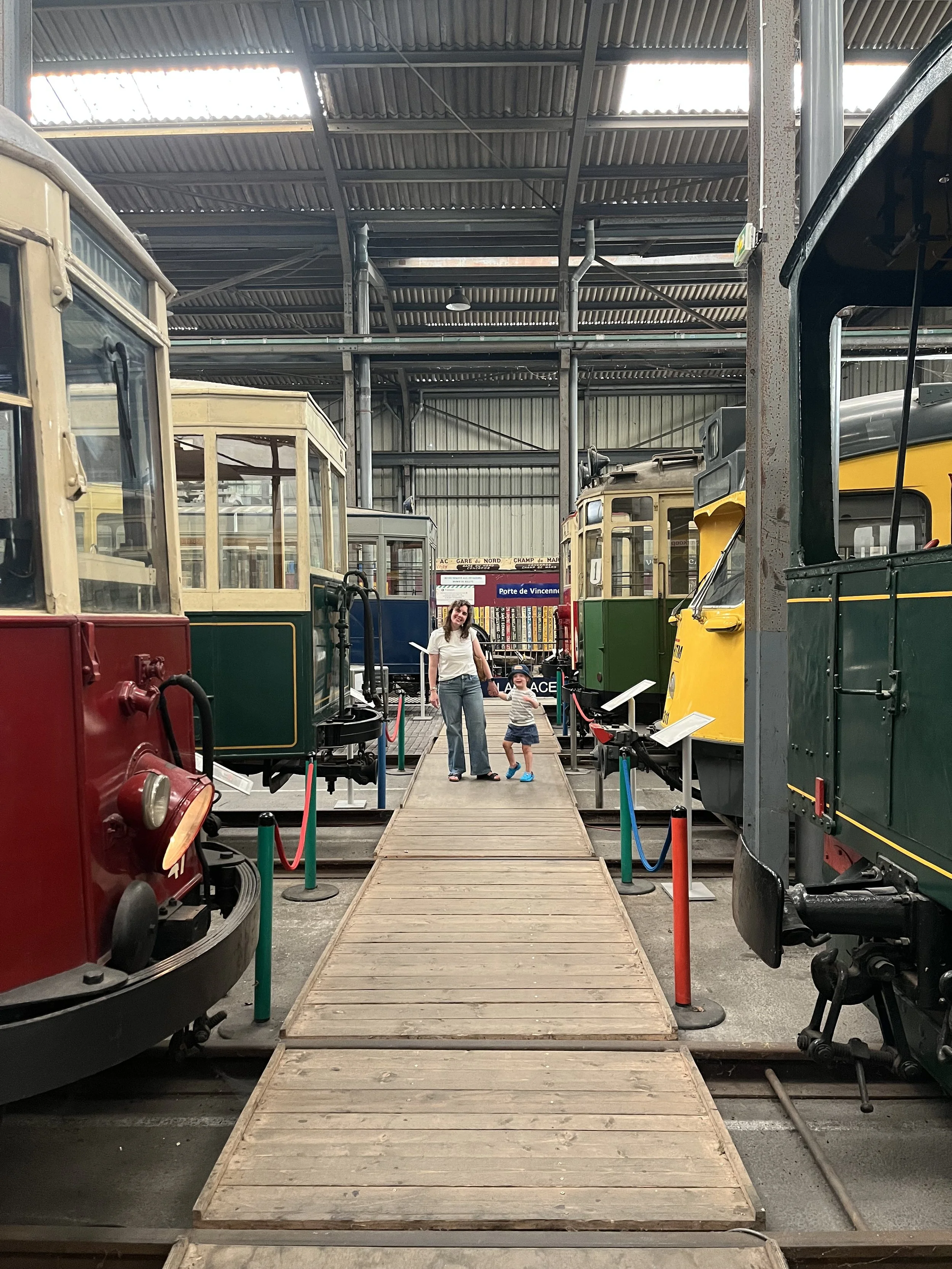
Auggie insisted we walk through the museum twice. On both passes, he stopped in front of the model train, on which the toy engines and cars ran in the same track over and over again without any switches or changes, and watched nonstop for over 10 minutes. Toward the end of our visit, one of the volunteers opened up a very stylish French double-decker bus from the 1980s. Auggie and I got to climb to the top deck and look out the front window at the whole museum. It was a great day.
Katy’s parents have been visiting us this past week after climbing Mount fricking Kilimanjaro. How incredible is that? It’s been so nice to see them. The week leading up, Auggie kept asking for his “Didi and Papaw.” We had a couple of great dinners out: Magnolia, in Pigalle, where the chef and owner is from Louisville, Kentucky. If you don’t know, that’s my neck of the woods—I grew up about one and a half hours from there. He stopped out and chatted with us a bit, asked about culinary school, and after we finished dessert, he sent out a round of digestif.
We ate well there; some perfectly fatty lamb with green tomato and a housemade chorizo stuffed inside a jalapeno being the star for me.
“You can tell he’s from Kentucky because of the green tomatoes. That’s not very French of him.” - Katy
We also ate at a spot in the 11th called Tram130, a French and Vietnamese restaurant that was both interesting and impressive. Todd and I both got the monkfish (a fish that’s so ugly that in France they won’t sell it with the head on), which had been gently poached in a court bouillon, and was served with a sauce Americaine (which is made with lobster), fresh herbs and some brunoised lobster as a garnish.
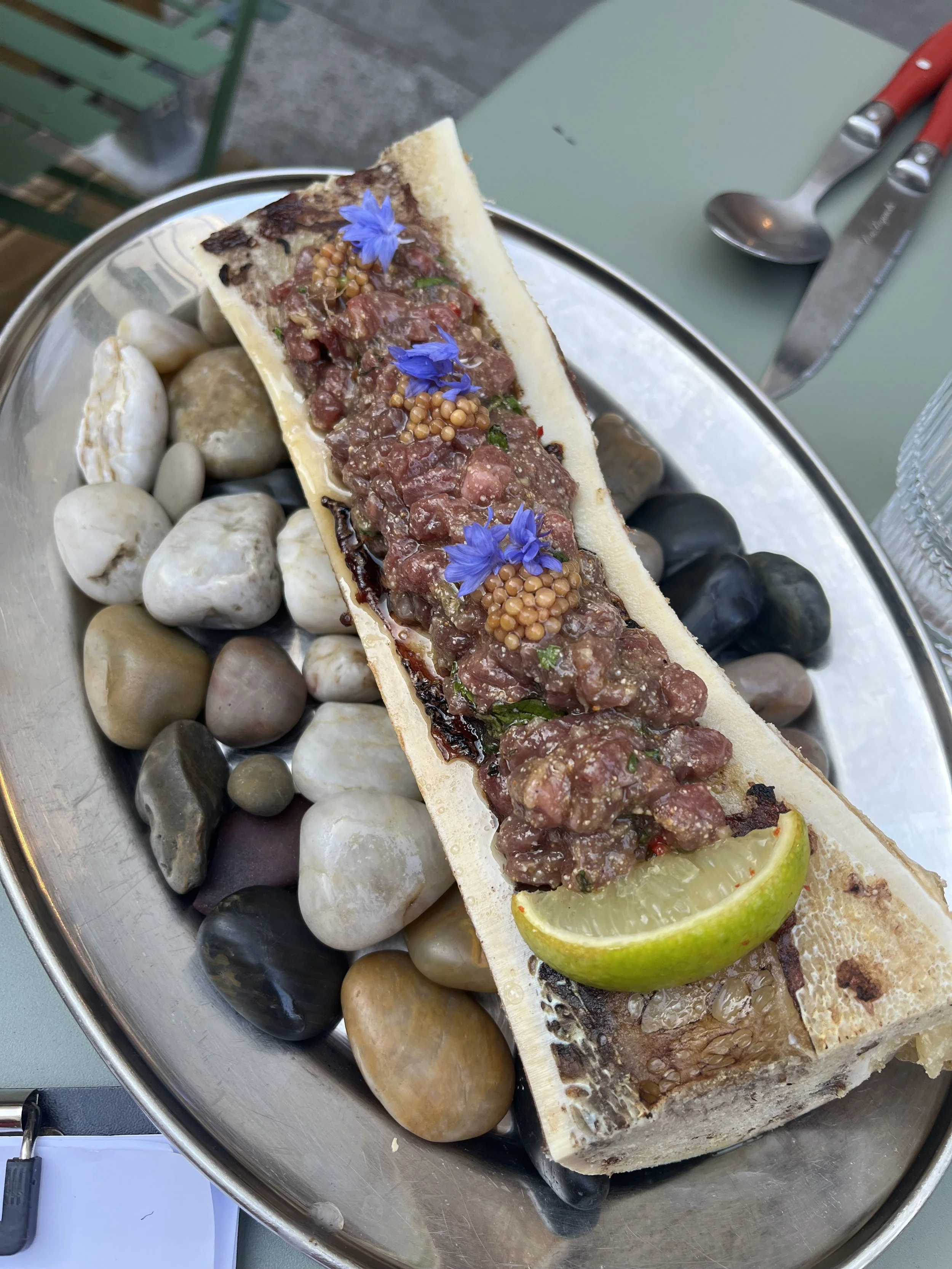
What stole the show, though, were two of the entrées. A signature dish at Tram130 is their Os à Moelle —roasted bone marrow. Bone marrow has had its day in the sun, but it’s starting to pop up on more menus in Paris, which I think means a resurgence is due back in the states soon too. For me, I never got bored of it. Not unlike foie gras, it’s delicious, melty meat butter. What makes Tram130’s great is that they top it with beef tartare. It brings the bite full circle.
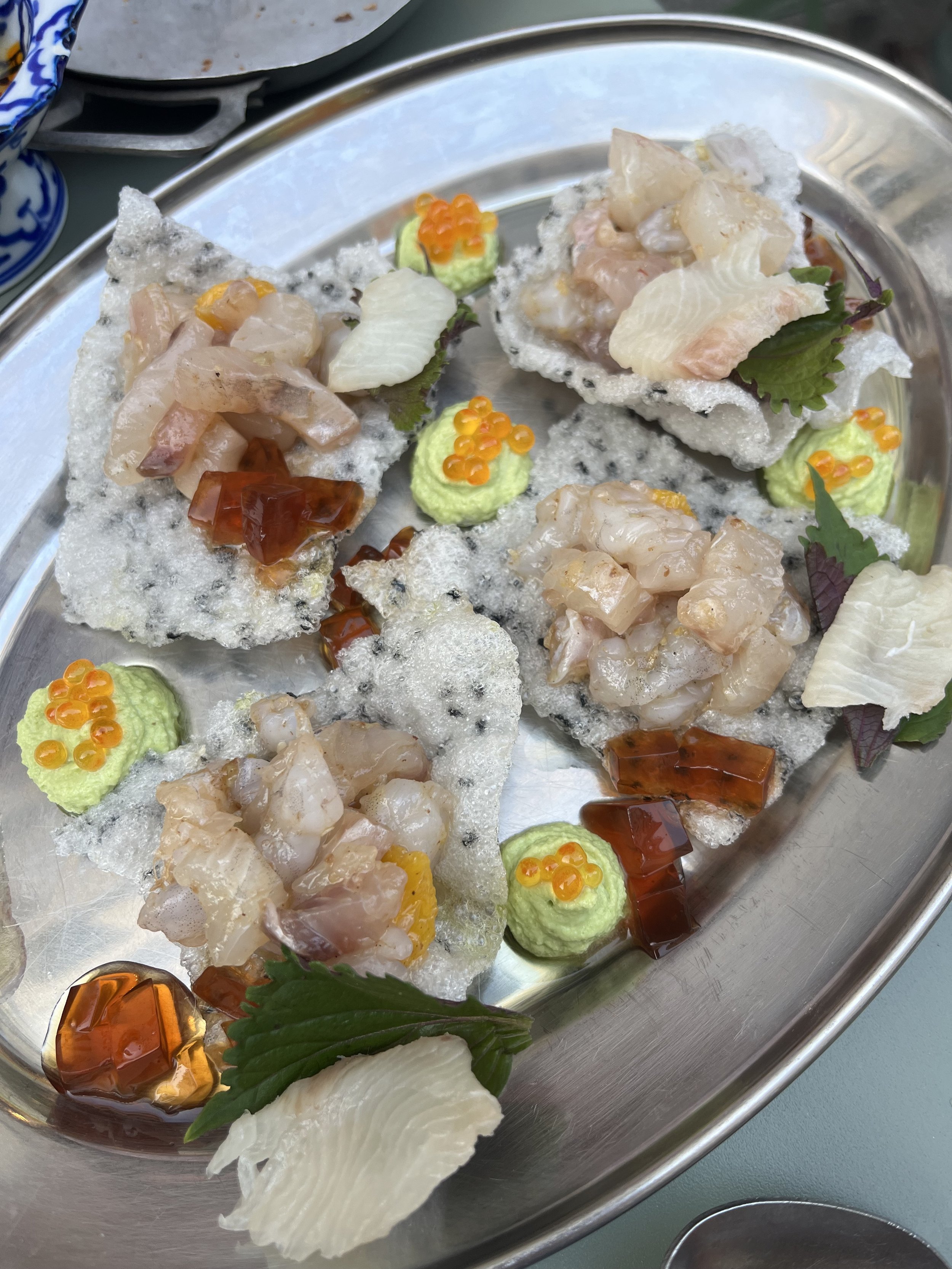
The other entrée they call “Ode a la Mer” (ode to the sea). It’s a crudo of black mullet, sashimi of amberjack, shrimp, and trout roe, all dressed in a vinaigrette of tamarind and shiso, with gelée cubes of ponzu (think soy sauce with citrus added), all served on a fried sesame cracker. Writing this, I can still taste that bite.
Before dinner, we had a quick apéro at La Cidrerie du Canal. It’s a spot that exclusively serves ciders. Some of you may be familiar with our foray into apple-growing, but if you’re not: when Harrison died, my father-in-law discovered an apple called the Harrison. It was once a near-extinct varietal that grew primarily in the northeast. It was planted extensively by Johnny Appleseed and would almost certainly have been considered an invasive species. But it was also considered the ideal apple for making cider: the perfect blend of tannin, sweetness, and acidity. It was brought back from the brink of extinction by two men who found a single example on a farm in New England. Since then, it’s made something of a comeback—far from being a household name but also now in no danger of disappearing altogether.
You can imagine why that story resonates with us, as Harrison’s parents. So we gave out Harrison apple trees to family members to plant, and we ourselves planted 50 on my parents’ property in southern Indiana. (All but 10 of that first planting died, so after some extensive soil fertilizing and manipulation, we planted 50 more. From what I hear, about 35 of them are alive today.) Once these trees begin producing fruit, we will make batches of cider each year to honor our boy, so that we can raise a toast to him around his birthday every fall.
I tell you all that to help you understand why visiting that cider bar, getting a better understanding the ciders of France (and England and Scotland and Spain) and getting an even better taste for them, mattered so much.
Naturally, I also cooked for them. The first evening, we had sea bream (cooked unilaterally, a technique which gently cooks fish on the skin side and leaves the entirety of the flesh juicy) served with a basil beurre blanc, zucchini and squash cooked in a pesto made with fresh basil and toasted cashews, and as usual a simple green salad with a red wine vinaigrette. For dessert, we saved my arms and I made a rhubarb, apple, and blueberry tart.
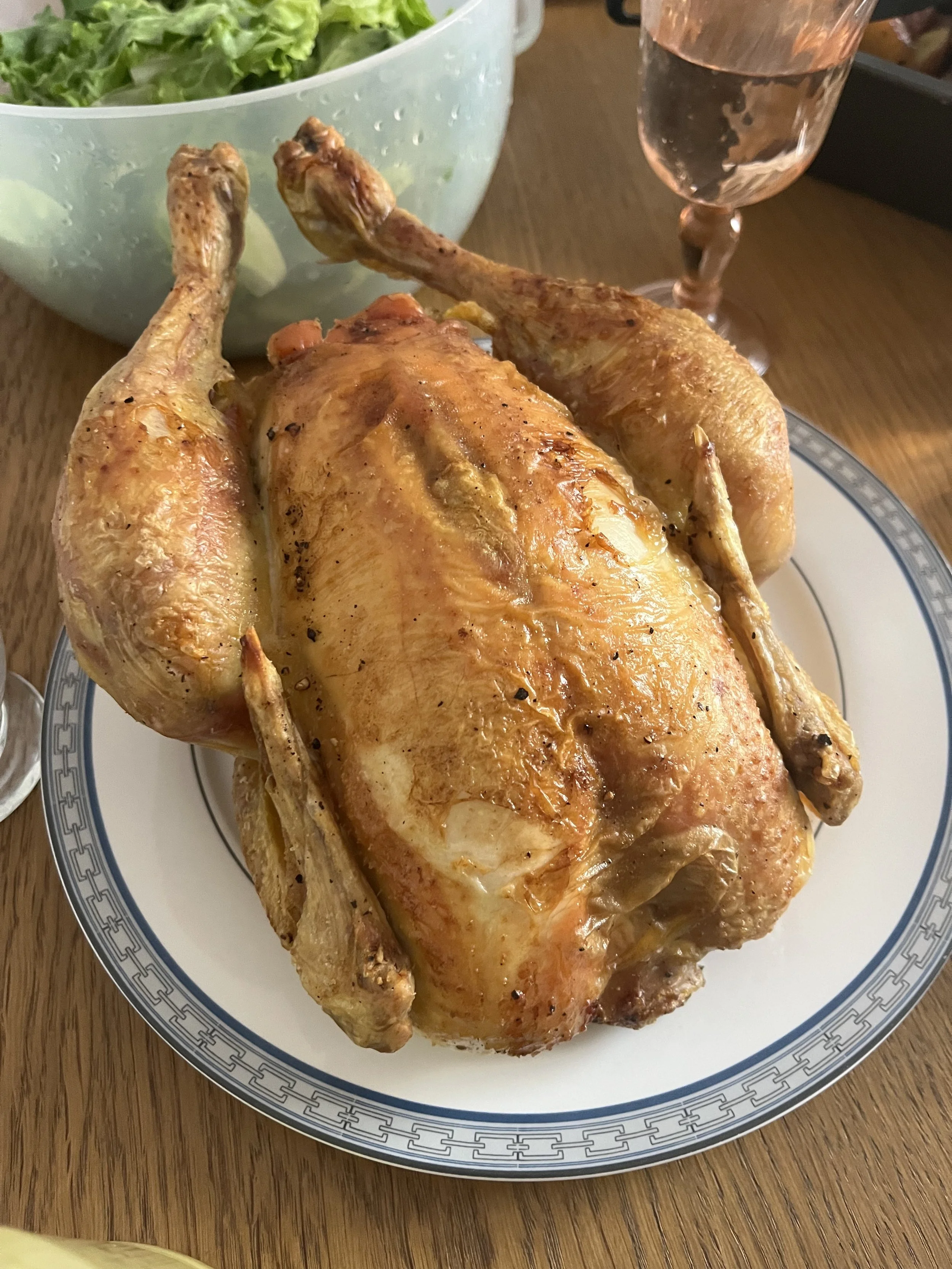
The second evening, we went about as traditionally French as possible. A roasted chicken with red potatoes, and a jus, plus another simple green salad. That was all. You don’t need much else.
On Sunday, we camped out in Montmartre to wait for the last day of the Tour de France to roll through. The cyclists climbed the hill leading to Sacre Cœur three times. They delayed the start due to the wildfires raging through France right now, so while our day started at 10am, we didn’t see the racers roll through until about 7pm. It was a long day, and Auggie hung as long as he could before Katy tapped out and took him home. Todd, Di, and I got to watch three very intense laps by the best cyclists in the world in a very dense crowd of people yelling (what I presume are) football chants back and forth across the street. It was thrilling, if a little exhausting. Who knew your legs could hurt so much just…standing there.