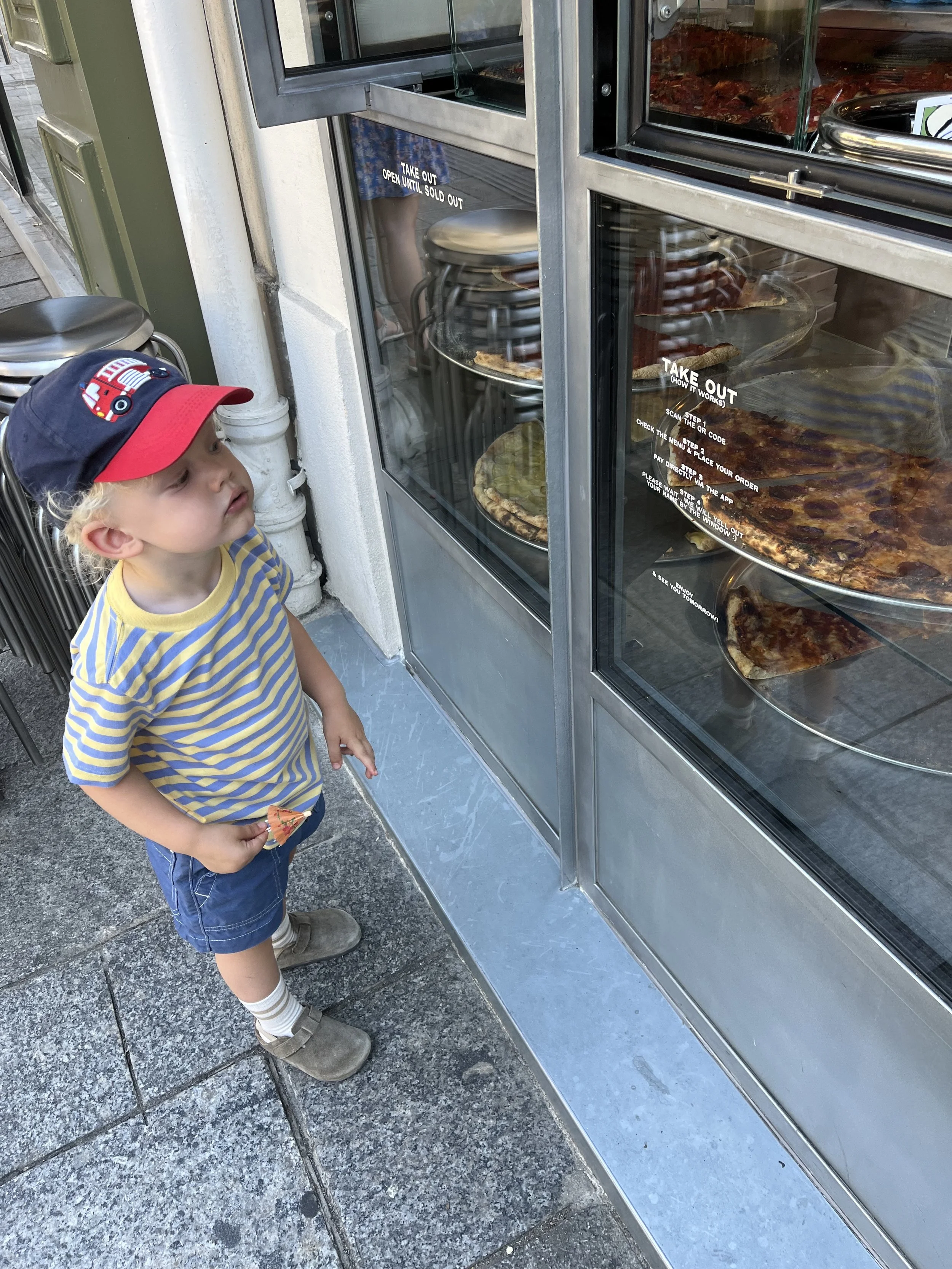
“Pas Mal” - Not Bad
It’s the beginning of the end. Superior cuisine has begun, the final stretch. An entire life change that Katy and I planned and schemed and dreamed and cursed and cried over for nearly a year is in its final phase. It’s a little surreal. We’ve started to plan what it looks like to come home to the US. We’re thinking about what we will need for the rest of our time here, how to empty our pantry in our little apartment, where everything will go, what gets shipped home.

But before all that, there’s more to cook. Chef has warned us that many of the recipes in Superior seem “easy,” but that they’re looking for more. They want to see details refined. They want to see perfection on the plate.
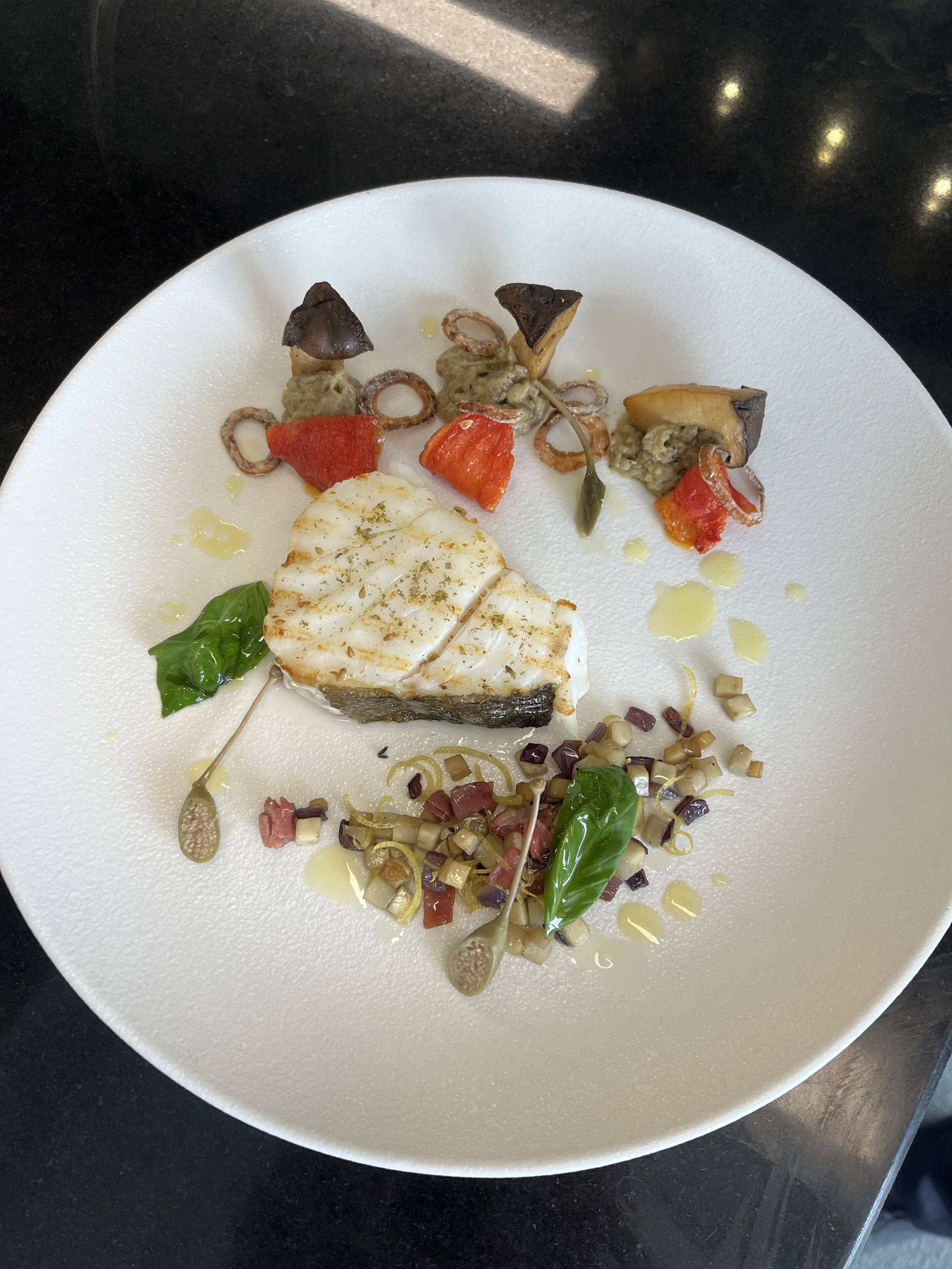
Our first dish was a nice intro: a grilled steak of cod, served with eggplant caviar (which has nothing to do with fish eggs and is actually just a simple dish made of roast eggplant and garlic), a sauté of artichoke, mushroom stem, an onion, semi-dried tomatoes, small fried onion rings, and trumpet mushrooms. Chef, when stopping by my station to assist me in cleaning the artichoke (at some point, someone looked at an artichoke, which is technically a flower, and said, “I’m going to go through the unnecessarily complicated process of cleaning that thing so I can eat it”) and complimented how sharp my paring knife was.
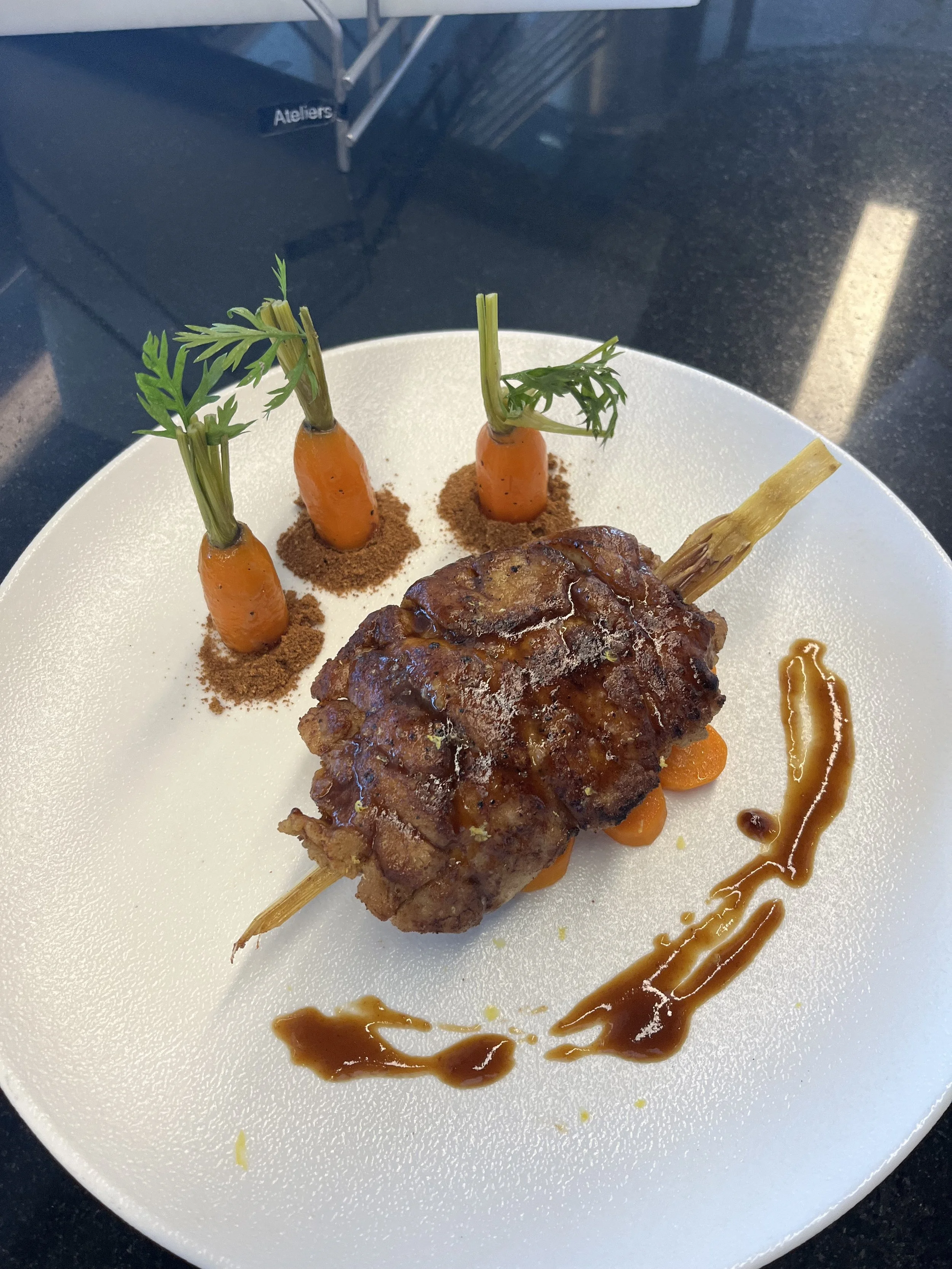
In the second cook, we made ris de veau which translates to “veal sweetbreads.” If you’re unfamiliar it is absolutely nothing like what it sounds. To me, this is one of the greatest bait-and-switches in the culinary world. Because how frequently would people eat this delicious treat if you called it a “thymus gland”?
We skewered it with half a stalk of lemongrass, browned it on one side in olive oil, flipped it and then basted in an unholy amount of butter for a very long time. They’re delicate, fatty, rich, and I love them. I’ve eaten them fried before as well, plus a few other preparations—not only here in France but around the world.
Offal isn’t generally my favorite bite. I enjoy some liver—particularly foie gras. I’ve eaten some rognon (kidney) in Lyon. Chicken giblets (an all-encompassing term for heart, liver, gizzard, and occasionally other parts) were one of my dad’s favorite snacks when I was growing up. He got them at the hot food section of the gas station in the nearest town, but I can’t remember eating them. They were too strange for young Cy.
After the demo, when Chef prepared the sweetbread for us and we tried it, a younger guy in my class asked for more details about it: what it actually is, where it’s found, what it does. The thyroid gland is usually found in the neck. It produces white blood cells, the ones that fight infection. It’s covered by a membrane that’s removed after blanching. To me, it’s surprisingly large—but then again, even a young cow is pretty big by most standards.
He started asking questions, not dissimilar from those that I’ve asked before. Mainly: why did someone ever think to try this? The answer, unfortunately, is hardship. Famine makes people look at potential food sources differently. And why let things go to waste? In the same way that someone once looked at a crab—what is essentially an alien-looking ocean bug—and said, “I want to eat that.” You find it a lot in France: cuisine built from years of war and toil.
At the lockers after the demo, the same guy said to me, “I can’t believe I just ate thymus.” I asked if that was his first time having it. “What? Yes. Obviously. Have you eaten that before?” I told him yes, several times in fact, I really enjoy it. He looked at me for a couple of beats before saying, “I think I’ll just stick to steak.” Call me adventurous, I suppose.
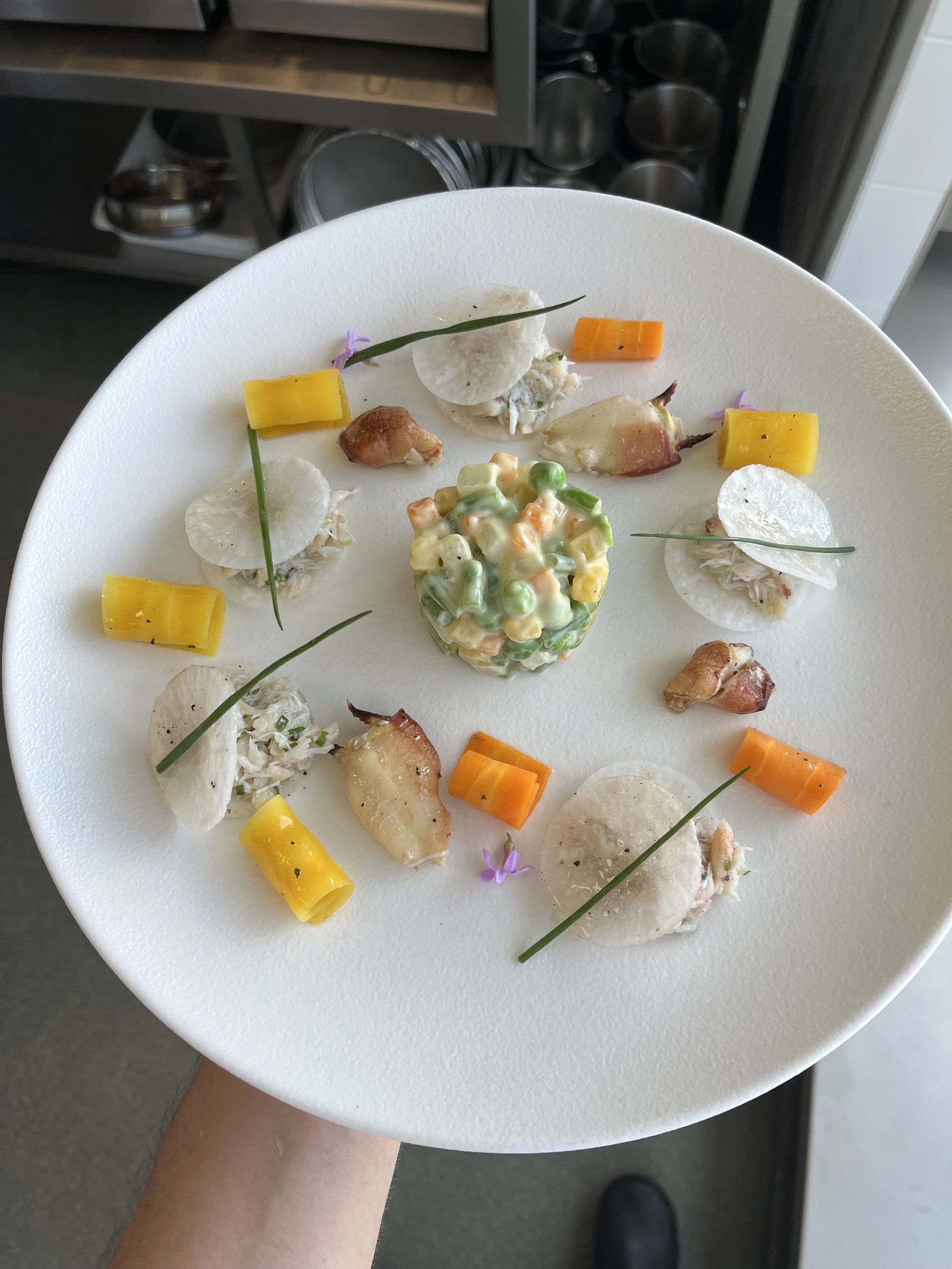
Superior includes two “ateliers” (workshops) in which we have to create our own dishes. We’re given a list of ingredients to choose from, as well as a handful of ingredients we must use, plus a few techniques we must showcase. For the first atelier, we must make an entrée (remember, this is what we call an “appetizer” in the states) using tourteau (European crab), then a plat with a de-boned chicken breast and cuisse—the thigh and leg together. I’ve only got a few days to put together an idea for these two dishes, an ingredient list, a plan for how to cook them within a limited time frame, and a sketch for how I intend to plate them artfully.
There’s also a “mock exam” which is really just practice for the final exam. We’re given a dish to make—and we know what it is this time, a pan-seared sea bream filet—as well as an entrée dish of our design using shrimp and sweet potato, among a few other ingredients. The whole thing feels a lot like being on a cooking show.
As we’ve had friends visit, I’ve made a meal for nearly every one of them (sorry if I missed you). With each, I’ve gone in blind with no real plan or design. I go to the marché, see what looks good, design a meal in my head, and bring it home to cook it. So far, so good.
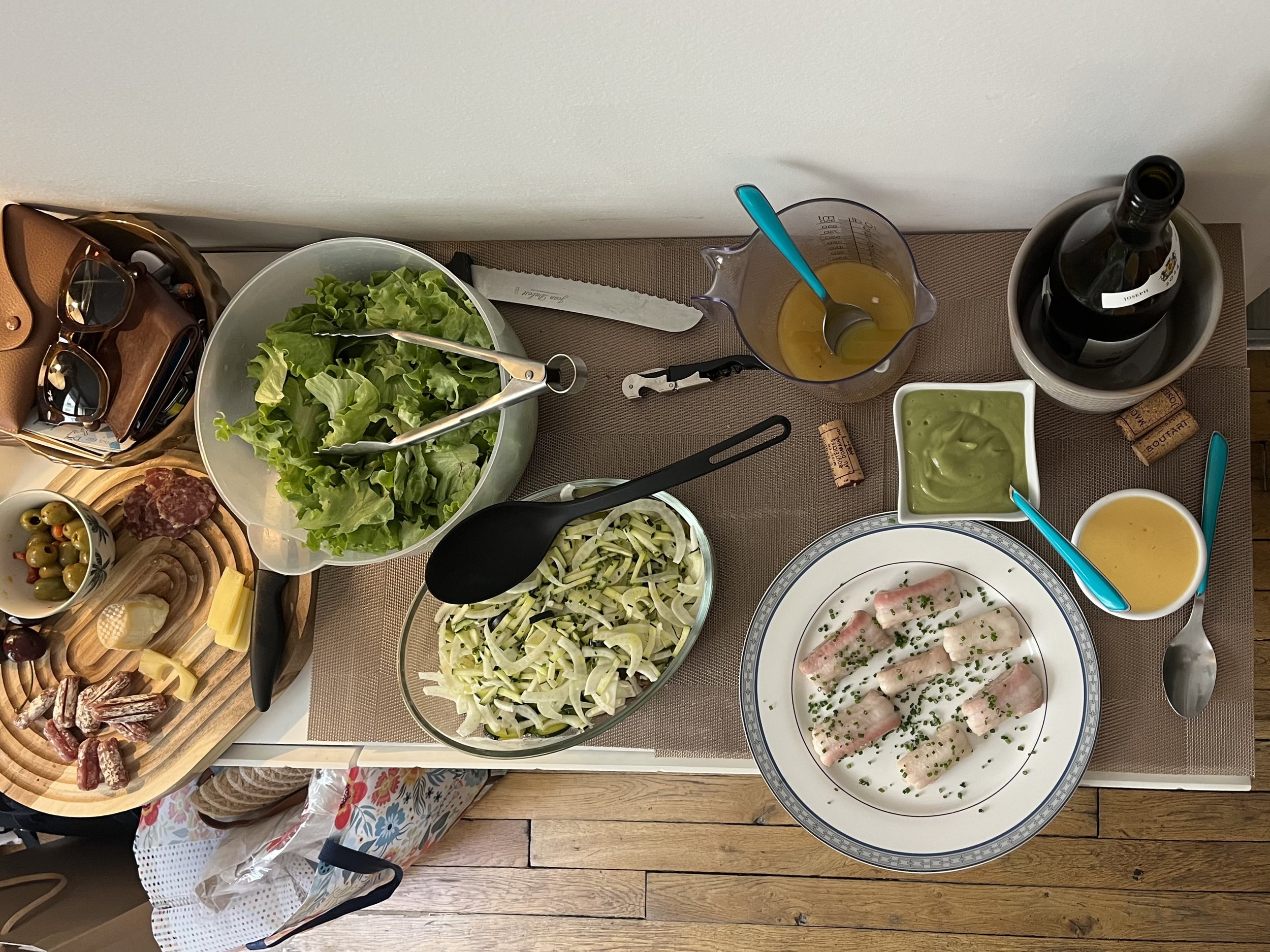
With our most recent visitors—some of Katy’s family friends going way back—I stuck to the same plan. At the Bastille Marché, which Katy described as “huge and exciting,” I picked up: two sole, four small zucchini, one long eggplant, a bulb of fennel, some beautiful fava beans, a head of bibb lettuce, a flat of strawberries, and half a kilo of cherries.
So far, sole is my favorite fish to work with. It makes sense to me. It’s easy to filet, easy to cook. It’s delicate and flavorful, and takes incredibly well to sauce. I wanted to pair it with a beurre blanc. This is a relatively simple sauce made by reducing together shallot, white wine vinegar, and white wine, before adding a lot of butter. You emulsify it together and keep it warm. Perhaps my favorite sauce, with my favorite fish.
Many of the vegetables became a riff on ratatouille (or more correctly, a tian de legume). The eggplant and zucchini were sliced thin. The eggplant was sautéed thoroughly, while the zucchini was half-cooked. I reserved some raw zucchini to top, as well as the thinly sliced raw fennel bulb. Dressed with a light coating of olive oil and salt.
The fava beans were shucked from their pods, cooked in salted water, shucked then from their sleeves, then blended into a purée with some fish stock.
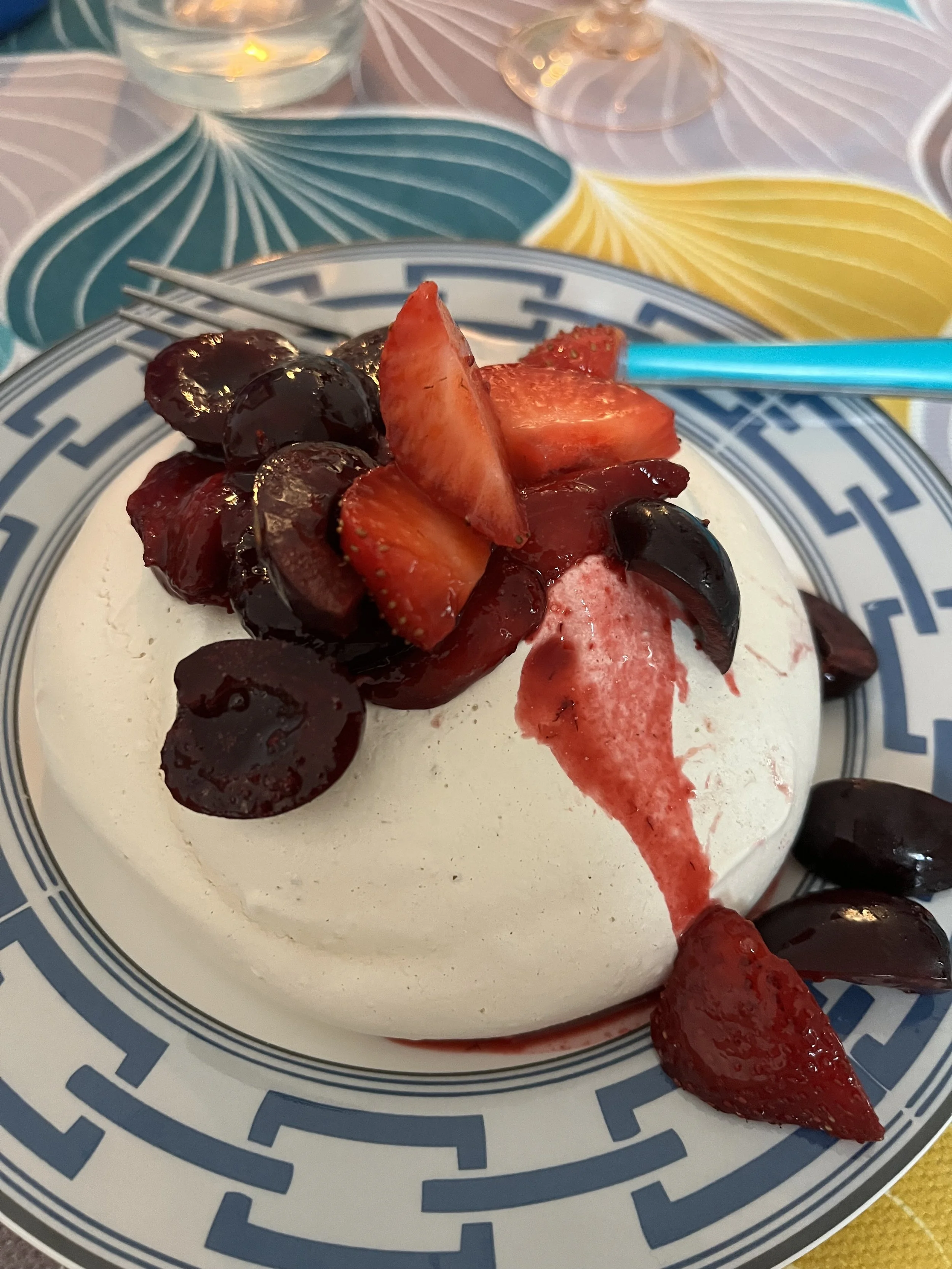
Now, dessert. My intentions were to turn the strawberries and cherries into a filling for a tart—summery, bright, and delicious. Katy had other plans. She asked for a pavlova, an Australian or New Zealand dessert named for the ballerina Anna Pavlova. It’s a sweetened meringue that’s thoroughly baked, creating a hard shell on the outside while the inside turns into a gooey marshmallow. It’s topped with whipped cream and fruit.
In class, we’re rarely afforded the opportunity to use a stand mixer to whip anything. We do it by hand, with a whisk, perhaps to show us that we can cook even when we don’t have our electric tools. On frequent occasions, I’ve thought my arm might fall off—in fact, I’ve wished it would so I wouldn’t have to keep whisking. But I’ve never whipped a meringue by hand, especially not to the stiff peaks required to make this dessert.
To paraphrase the American poet Meat Loaf: I will do anything for love. But I won’t do that again.
Even getting the egg whites to a soft peak—the point at which you add sugar—made me stop twice to throw the bowl back in the freezer and rub the entirety of my arm from my shoulder to my wrist to help release the tension. Sweat gathered on my forehead, started to soak my hair. I was gritting my teeth. Once the sugar was added, it took on the consistency of glue. Katy tagged in for a couple of minutes and helped immensely. A recipe I read online said it should take about ten minutes in a stand mixer on high speed. It took me all of about 45 to finally get the glossy look the meringue needs in order to hold their shape in the oven.
But hold their shape they did thanks to sheer brute force and a stubborn ego.
Meanwhile, I halved the strawberries and halved and pitted the cherries. Half of each went into a pot with a bit of sugar and a couple of sprigs of thyme, then cooked down into a soft, syrupy compote. Our pavlovas were served with a mix of fresh and cooked fruit. They were beautifully crispy on the outside and like a perfectly toasted marshmallow inside.
Our friends—from whom I’m taking the opportunity to learn as much about wine as possible and intend to continue that education after we’re back stateside (I know you two are reading this, as well, so this is me inviting myself over)—brought three lovely bottles of wine. A Greek Assyrtiko, which I’d never heard of and yet loved; a Mâcon-Bussières Les Clos; and a brilliant Montagny Premier Cru Les Bouchots. I contributed a bottle of Jim Harrison’s favorite wine: a Domaine Tempier Bandol, from 2022.
Katy told me at the end of the night it was my most complete, well thought-out, and seasoned dinner I’ve put together so far. For that, I’m quite happy.
On Mondays, Katy works later hours due to meetings that are held at perfectly reasonable times in the states. That means Auggie is hanging out with me, and that usually he’s my sous chef in the kitchen while I make dinner. This job includes such tasks as standing in between me and the counter while I’m trying to cut vegetables, asking to try literally every ingredient I’m using, and putting all of his little Hot Wheels cars throughout our very small kitchen floor so that I’m also navigating an obstacle course while cooking.
He also talks to me non-stop while I’m at it. I’m going to try to type out a conversation we had recently, if I can remember all of it.
Auggie: “Look Daddy Daddy look what’s this what’s this what are these these things look at this what are these what these things doin’ what’s what’s what’s what’s (breath) what’s this thing look at this daddy look daddy look daddy daddy look at this these things look at this what’s these?”
Cy: “Those are magnets, buddy. They stick to metal things like the fridge.”
Auggie: “Mag-uh-nents?”
He’s also developing something that’s not quite a sense of humor, but he’s blending it with restaurant criticism. Recently at dinner, he was eating parts of Katy’s dish. Our family friend asked him if it was good.
Auggie’s reply: “No, it’s not good! [pause] It’s dee-wi-cious.”
The child also sees “train tracks” literally everywhere: the slats in the wood floor, the lines on the dining table, the cracks in the sidewalk, the geometric patterns of a rug. Often, we’re standing on the train tracks and we need to move to where it’s safe. Occasionally, he “gets stuck” on the train tracks. If not there, then he or his toy trains or cars get “stuck in the mud.” I’m not entirely certain where he’s gotten all this, but my guess is Thomas & Friends. Regardless, he has a wild imagination and I’m certain I know where he got that.