“Etoiles” - Stars
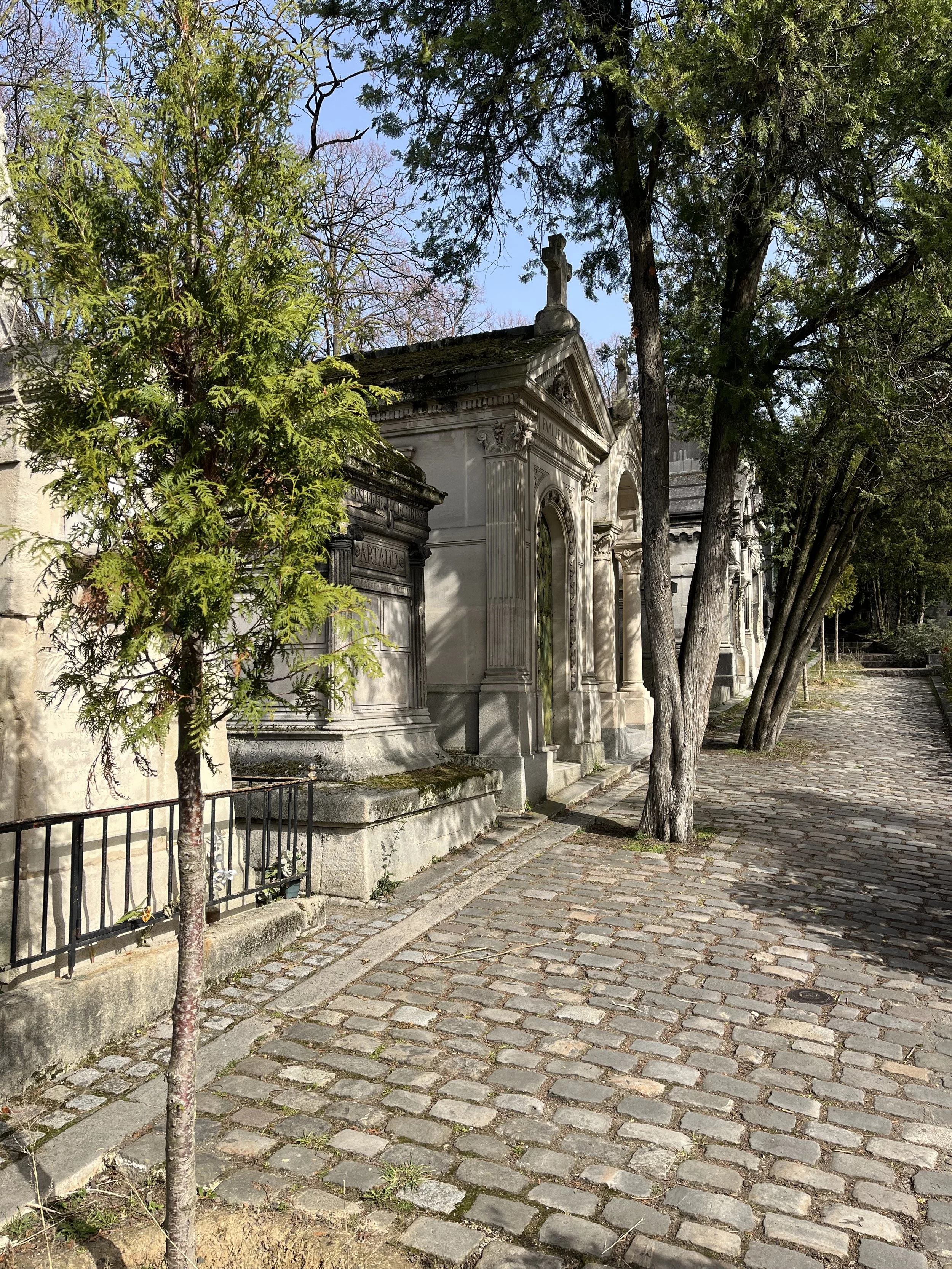
I’m standing in la Cimitiere du Pere Lachaise. The tall, ancient canopy of trees is just starting to bud and open up, the grass turning green and filling in again. It’s a maze. Miniature mausoleums everywhere, with very little space between them—barely enough to walk, and sometimes not enough at all. I think, “These bodies must be stacked on top of one another,” both literally and figuratively. (Turns out I was right.) While I look around, I forget that I’m in a city of the dead, it’s so gorgeous here. We reserve so many of our beautiful spaces for our bygone loved ones. And rightfully so.
I’m here to see the grave of Jim Morrison, lead singer and lyricist of The Doors. It’s a small spot, surprisingly so, hidden almost discretely beneath a tree and behind another small mausoleum. An older couple is standing at the safety gates in front of it, put up to keep rabid fans at bay. Still, his grave is covered in trinkets, guitar picks, handwritten notes, and fake flowers. Jim was just 27 when he died—an age that to me feels like forever ago.
In fact, many of the graves of the famous here are remarkably small. The grandiose tombs, I learn in real time, belong to politicians. They look out of place. The humble spots seem to be all anyone could need, especially where they are.
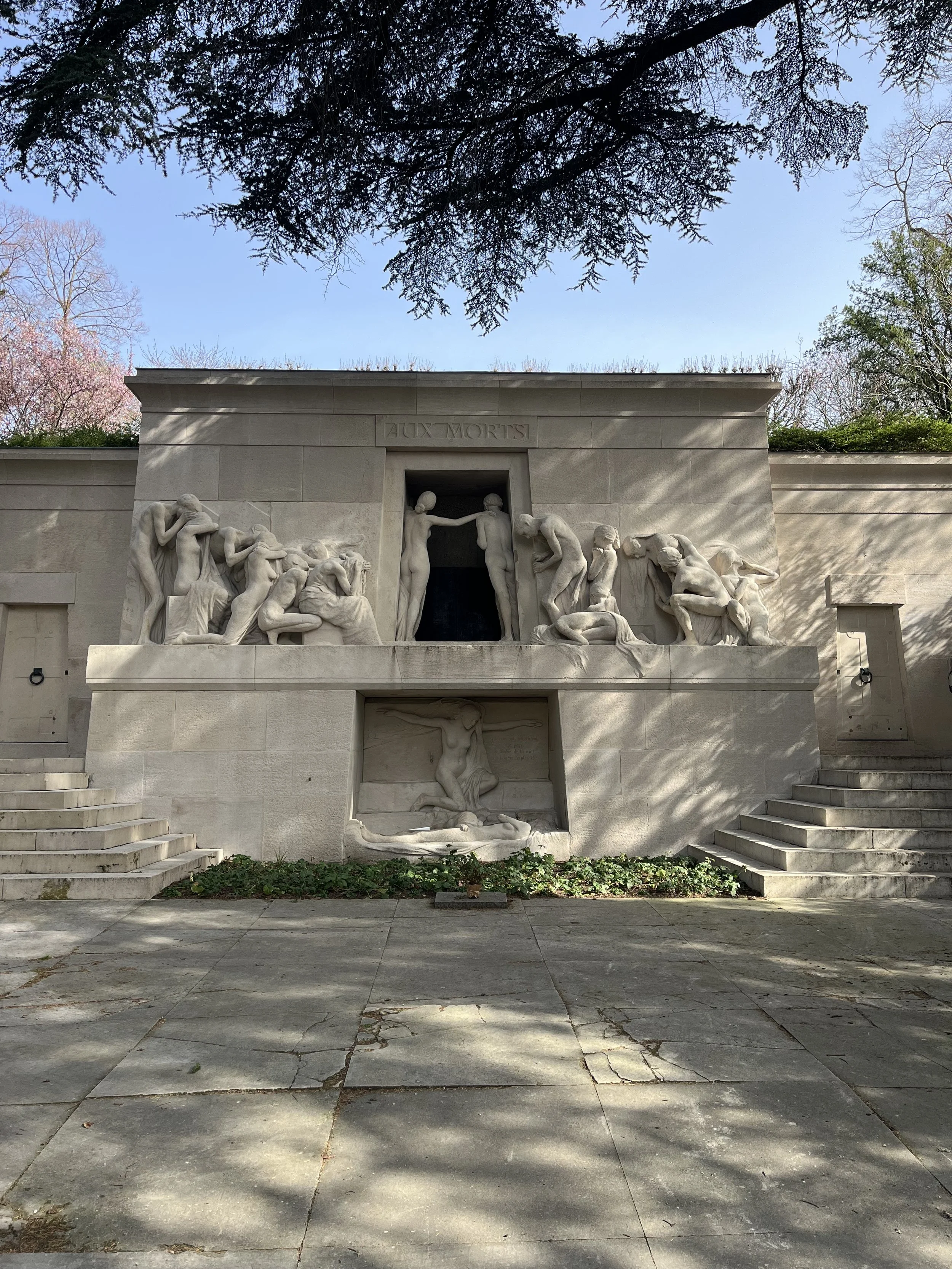
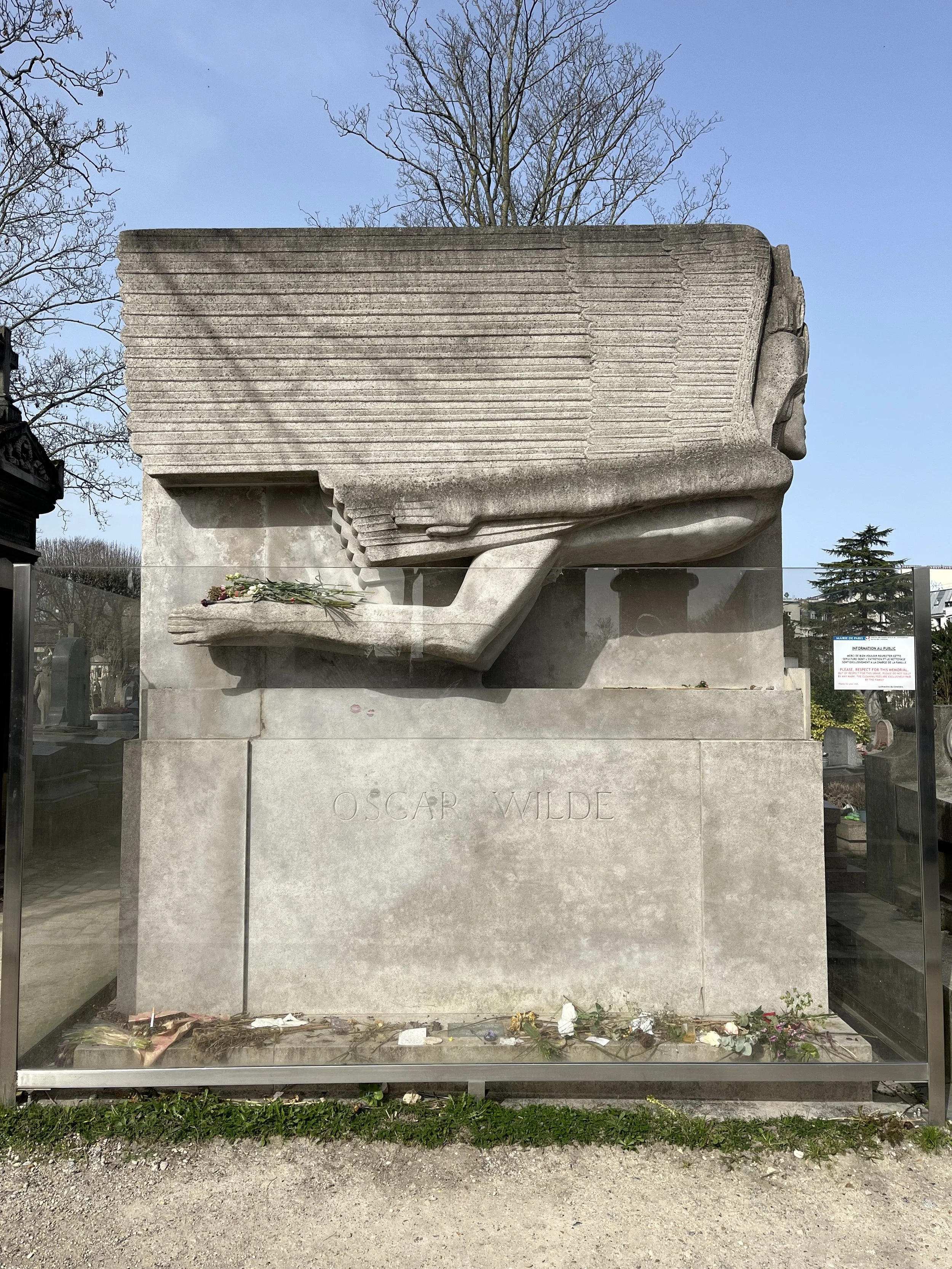
The winding stone pathways and stairs—this entire cemetery might be uphill—are worn smooth from over 200 years of mourners and the curious (I count myself in both categories) wandering through the internments. Walking, I find the resting places of other names I know: Oscar Wilde, whose grave is famously covered in lipstick kisses (enough so that they erected a glass shield to help prevent it); Honoré de Balzac, whose apartment museum I wrote about previously; Marcel Proust; Frédéric Chopin; the impressionist Camille Pissaro; and Gertrude Stein. And that only covers some of the literary and artistic figures. There are, literally, over one million people buried in this cemetery, either in private spots or in the Aux Morts, an ossuary built to house the remains of those without names.
I try to imagine the lives of over a million people interred here. To even imagine a million people. To picture lives from the 1800s, 1910s, and on. People who lived and died before I was born. People who were born after I was born who have already died. And I can’t. It’s too big a number. It’s too many people.
Several years ago, on a large family trip to the Bahamas to celebrate the life of Katy’s grandmother, we took Harrison to the beach—an empty strip of sand where the waves came crashing and ran up the coast. Harrison was afraid of it. So I held him up and we looked out at the ocean, so huge and vast and endless. All the way to the horizon. He held onto me tightly as the water lapped at my ankles, and it was all ok. I had him, he had nothing to worry about. Dad was there.
Katy captured that moment in a picture and I’m so thankful. It’s one of the most important moments to me as a father—especially on this side of Harrison. I can think about the ocean, how unfathomably large it is, and look up at the moon visible in the daytime sky. And think about the number of people who came before us, and who will come after us. Collectively and individually, we are all so insignificant. The things we do each day just a minor blip in the history of this planet. But that boy, to me, at the time, was my entire world.
For me, the most I can hope for is to be remembered fondly, hopefully for a while. If I do anything to create any longevity, to give people something after I’m gone, all the better. It’s what we’ve tried to do for Harrison’s legacy. And seeing the graves of these artists was a reminder that brilliant art continues to live. Music and writing and sculpture and painting. We can make things, even though—and especially when—life is hard. These days, when we hear someone complain about the aches and pains of age and how getting old is hell (a favorite quote of my parents), Katy has started to say, “Getting older is a privilege.” And so it is. Because the alternative is that we do not.
The new Harry Styles—who is Katy’s “boyfriend,” if you’re not aware—album has been on pretty serious rotation in our Parisian apartment. It’s full of heavily electronic and post-punk bangers. “Taste Back” is a personal favorite. We’re seeing him at his first show of his tour in Amsterdam in May. Meanwhile, the perks of living in a major global city have paid off for Katy who had the chance to visit a Harry Styles pop-up store selling merch for his new album. While she stood in line, Auggie and I walked the area around Les Halles.

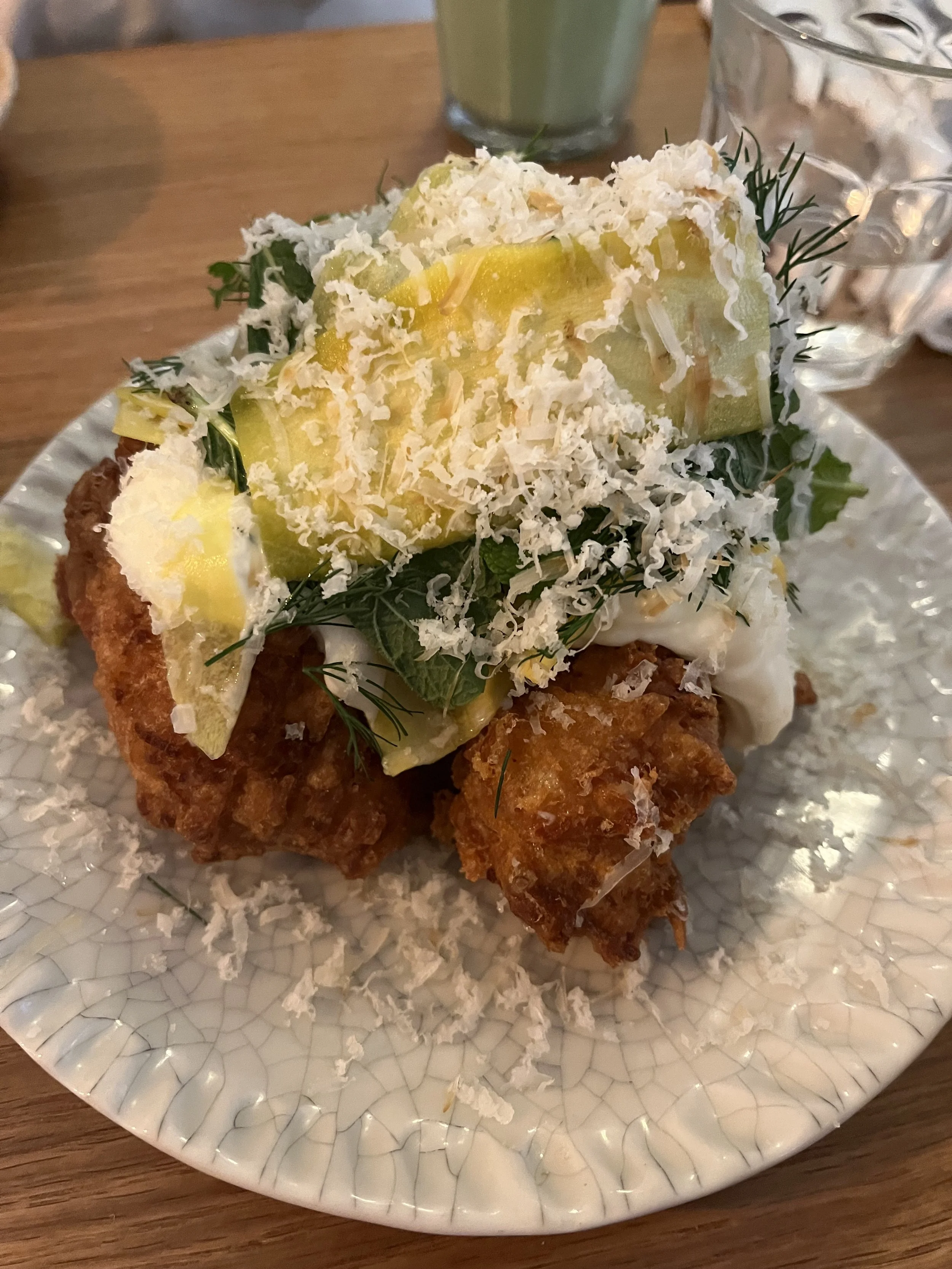
Afterwards, in a day themed strictly about Katy, we found a “ressourcerie,” a French thrift store. Fine by me, as we were near Rue Monceau, a great street full of great restaurants. We ate at a small spot called Chez Carrie for “brunch,” which isn’t really a thing the French do, but the meal was astounding. Our starter was butternut squash croquettes and they were phenomenal.
We’re in an effort to eat at more places. Most of our meals are cooked in our miniscule apartment kitchen, by me. But we’re in Paris, so let’s eat, you know? Last weekend I made a reservation at a spot called Les Animés. I found it in Gault & Millau, a kind of French-specific not-quite-Michelin-level Michelin Guide. It got good enough reviews and was close to home in the 15th, so why not? I came away feeling like I didn’t order very well, but Katy’s stuffed chicken breast was the best chicken breast I’d ever eaten. Really, genuinely, perfectly cooked. I was both jealous and inspired.
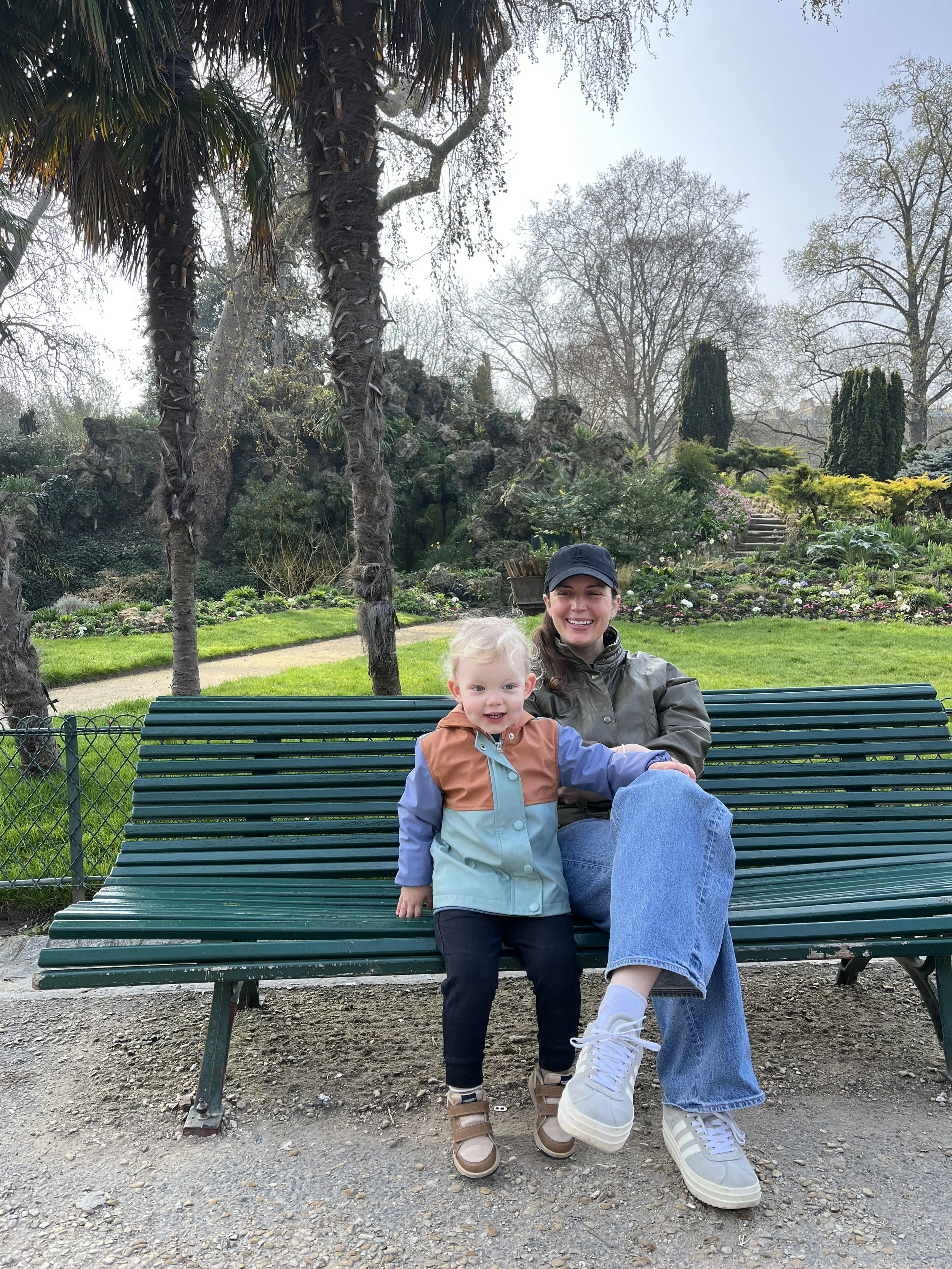
Speaking of jealous and inspired: recently we walked to Square Violet, our nearest park which doubles as being both a fun, beautiful spot with an aire de jeau and sits next to a fire department for added Auggie entertainment. After some time in the playground, we stepped over where several firefighters were coiling hoses outside a camion de pompiers. Auggie stood transfixed, pointing at it, telling us he saw it, asking us to look at it with him. I noodled for a moment on my phone before saying something to Katy, and didn’t get a response. When I looked at her, she was as transfixed as Auggie was. Looking up, I saw why: the two muscly firemen were standing shirtless, and changing.
“Are you in there?” I asked.
“Mmm-hmm,” she said. And a beat later: “You know, if you wanted to be a French firefighter…”
“I’ll run that by the embassy when I’m done with the chef thing.”
As of this writing, I just finished my final practical cook for Basic Cuisine. Katy suggested it might be fun to walk you through—maybe more briefly—what today looked like. We made paupiette de veau. It’s a veal escalope, pounded thin, stuffed with a mix of veal trimmings, mushroom, breadcrumbs, and pork sausage. It’s braised and served in a sauce made from the braising liquid. This was a long, complicated dish and we had two hours and fifteen minutes to whip it up. I’ll skip a lot of the basic things (gathering equipment, wiping, cleaning, etc.), and try to focus on the actual cooking. Ready? On y va.
We begin by finely chopping shallot, mushroom, and garlic. Cut serrano ham into a small dice. Heat 10g duck fat in a sautoise until melted. Add shallot, sweat. Add mushrooms. Mushrooms lose a lot of liquid as they cook—they’re basically sponges. Cook until very dry. Add garlic and ham, stir and cook for another 30 seconds. Remove from heat, let sit.
The stuffing: we trim our veal escalopes to 80g. Each of mine is over 180g, so there’s a lot to trim. We’re aiming for something roughly circular. Trim, weigh. Trim, weigh. Trim, call it good enough. Reserve the trimmings. Chop them finely. Reserve 20g for the stuffing, and set 70g aside for the braising liquid.
Add the 20g of veal trimmings to 30g of pork sausage. Remove rind from pork backfat, chop into small dice, add to sausage. Finely chop parsley, add to the mushroom duxelles, mix together. Add cream and armagnac to bread crumbs, hydrate. Mix together veal, pork backfat, and sausage thoroughly. Add duxelles to sausage, mix. Add soaked breadcrumbs to sausage, mix. Cover with cling and into the fridge.
Take a big, deep breath.
The veal escalopes need to be lightly flattened. Throw one between a folded sheet of parchment paper, and pound on it with a pot until it’s thin, but not too thin. I’m not kidding. We do this. It’s so loud. Then do it again a second time.
Now let’s make the paupiettes. Cover the cutting board in plastic wrap—it makes cleanup easier. Place two layers of caul fat. This is the fatty membrane that surrounds the internal organs of some animals. And it is amazing. Place escalope in the middle of the caul fat layers, and scoop 80g of stuffing into the center. Pull the edges of the escalope up and around the stuffing. It’s ok if it doesn’t close completely. Flip it upside down, and wrap the paupiette in a thin strip of pork backfat—which is different than caul fat. Flip it again so the open side is facing up, then wrap it with the caul fat. Trim the excess. Pull it tight, flip it over, put in on your tray. Now do it again, with the other one. Once they’re both finished, truss them with kitchen twine into eight sections. Fridge.
In demo, chef said we should be an hour into our cook at this point. I’m at an hour and five minutes. Workable.
Now we prep the aromatic garnish—it’s what flavors the braising liquid. Matignon (that’s roughly a 7mm cut, and yes it is important that they all be accurate cuts because they’re used in presentation) the carrot, celery, and onion. Monder (which means to boil, ice bath, and peel) the tomatoes, remove the flesh and seeds, and cut into a dice. Slice and remove the germ from the garlic cloves. Make a bouquet garni (a lot of parenthesis in this section—this is usually a few thyme sprigs and a fresh bay leaf wrapped in the green part of a leek, tied with string).
OK, now we’re cooking. Well, almost. Season your paupiettes with salt, on all sides. Then roll in flour, coating, and patting to remove excess. Melt more duck fat in a frying pan. Add the paupiette smooth side down. This is the presentation side, and it’s always cooked first. You want the pan hot, but not too hot. Don’t brown too much because chef notices. They always notice. At a light brown, flip it over. Toss in your aromatic garnish and reduce the heat, let it sweat a little. Throw in some tomato paste, cook for about three minutes to brown it. Add your veal trimmings, brown them. Let them cook, let them get really brown. They’re there for flavor. Deglaze the pan with white wine, cook, and reduce by about a third. Now add your bouquet garni, garlic cloves, and tomatoes. Now the magic: 200mL of veal stock. It’s basically meat jelly. Let it melt, and throw it into a 210-degree (Celcius) oven. Set a timer for 25 minutes.
Take another big deep breath. Have you been breathing? I haven’t.
Now the garnish—the other pretty stuff that goes on the plate. Cut your lardons, which are essentially bacon, into 1 cm strips. Blanch them to get out the excess salt (yes, I know, it sounds sacrilegious as Americans but I’m in France, what can I do). At a boil, remove to a towel lined tray, let dry. Peel your pearl onions, get them into a small saucepot with a bit of sugar, butter, and water. Boil until they’re done, then reduce the liquid until it’s syrupy and caramelize your onions. Tourner the carrots. It’s harder than potatoes, they’re fibrous. The bird beak knife comes in handy but it still takes so much time. You have to plate three, so cook five—give yourself options. Add to a small pot, add water and butter. Cook until tender, set aside.
Almost done and that clock is ticking and chef is letting you know it.
Sauce time. The paupiettes are done. You’ve basted them three or four times, they look good, lightly brown, great. Remove them from the sautoir, please remember that the pan just came out of the oven and the handle is hot. Put them onto a cooling rack and cover with foil to keep warm. Remove the nicest cuts of carrots and celery for your garnish from the braise, and set aside.
(During this interaction, Chef: “What are you doing?” Me: “Reserving my veg for the garnish, chef.” Chef: “...smart.”)
Strain the braising liquid through a chinoise sieve into a smaller pot. Heat over high to reduce. Remove from heat, mount with 30g butter. Duh. Keep warm.
Almost there. Brown your lardons in butter, just enough for color. Add your reserved vegetable garnish to the sauce.
Now we plate. Pull the plate out of the oven which you so smartly placed in there after you removed the paupiette and turned off the heat. A circle of sauce and the garnish go in the middle. Drain the carrots on a towel lined tray, plate three of them. Plate six lardons, overlapping in three X shapes. Plate three of the golden onions. Decorate carrots with celery leaves and chive tops. Remove the nicer paupiette to your cutting board, remove the twine. Cut a small wedge, about an eighth, from it. Plate the paupiette in the middle of the sauce, the star of the show. Add the wedge. Spoon a bit more sauce on top of the paupiette. It’s gleaming. It’s done. Now get it to chef.
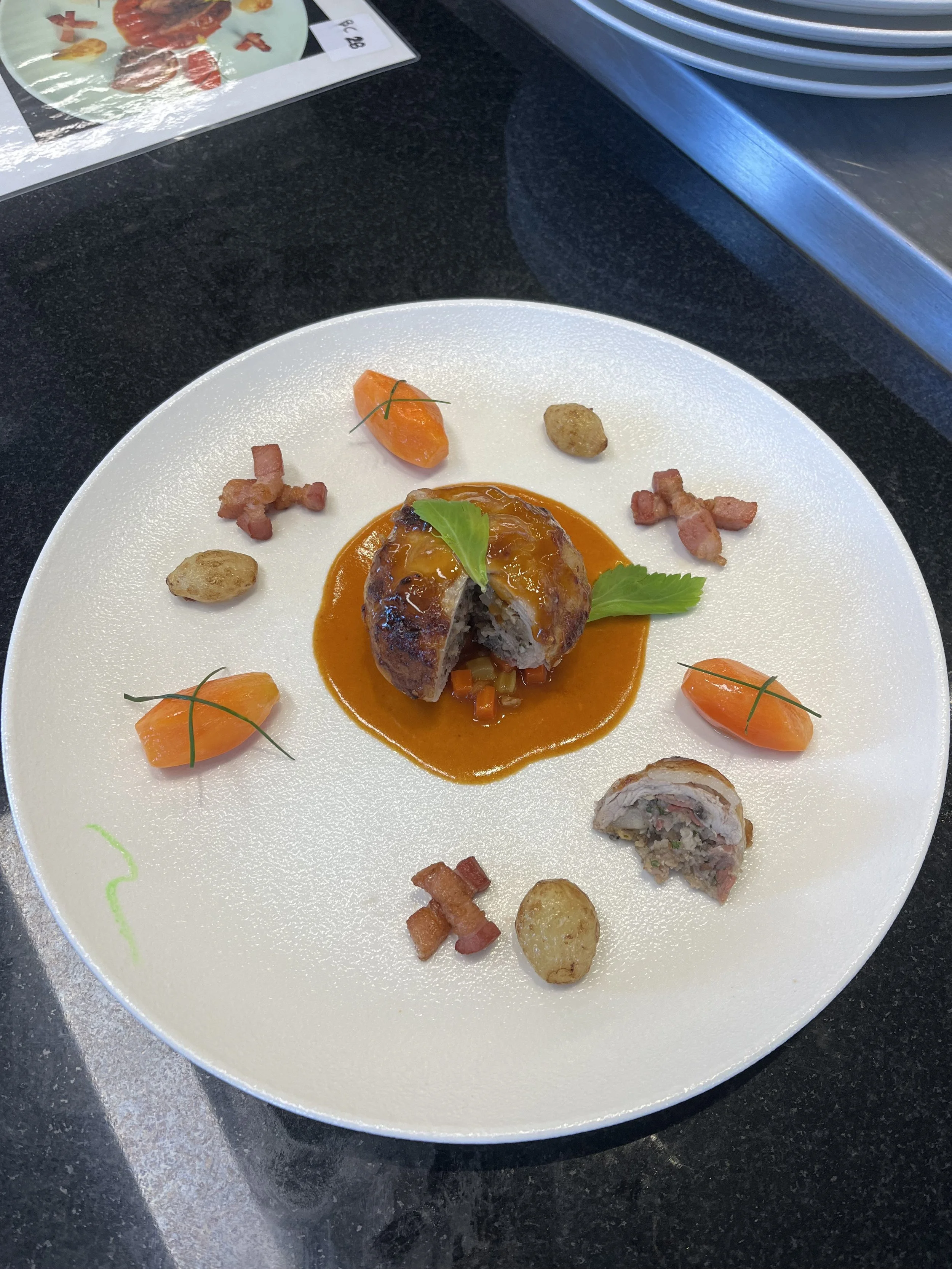
All of this took me about two hours and sixteen minutes. Chef had some good feedback, but I got a handshake out of it. He was happy, I’m happy.
In the locker room, I thought back to our first real cook of the class. A crudites plate. How long and slow that was, how it felt like every little thing took so long. I wonder how it would go now.
On a(nother) rainy day, I went to walk around a museum in La Marais. En route, I got a call from a French number. The woman on the other end told me in very good English that, because I was on the waiting list at Septime—a restaurant with one Michelin star and a booked-solid reservation list—a spot opened up and I could come for lunch at 12:30.
That derailed my plans for the museum, but turns out they wouldn’t have let me in with my backpack anyway. So I walked around Le Marais a bit longer, got drenched because of a shoddy umbrella, and decided to just make my way to the 11th.
I used to feel like a giant loser eating alone, but as an adult I got way over that and came to enjoy it. Not as much as I enjoy eating with Katy, of course, who has a palette that’s astounding and picks out flavors I can find no trace of. But it does give me a chance to sit and totally focus on the food in an environment where the food is the entire reason for existence. Inside, there are no white tablecloths. There’s nothing gilded or fancy for the sake of being fancy. The tables are raw wood. Front of house wears blue chambray shirts. It’s the opposite of pretentiousness because the focus is, again, on the food.
They sat me in front of the kitchen. I’ve always had respect for the kind of focus you need in a kitchen to handle orders—especially at a Michelin level—but seeing it first-hand after experiencing even a fraction of it at LCB has upped my appreciation. Between how fluidly the front of house handled service, including the wine pairings that I couldn’t not get, and how quietly and sternly chef handled both expo and stepping in on occasion when she needed to clarify things, there’s a lot of intensity that sets places like this apart.
Septime’s menu changes frequently enough that they don’t bother posting it online. I like that. One some level, it’s confidence: you’ll get what we give you, and you’ll like it. On another side, it means there’s constant creative evolution flowing through the kitchen. Lunch is offered in five courses (dinner is seven). I got the wine pairings because though I know precious little about wine, I was certain the program here would be thoughtful and interesting. (It was.) I won’t go into the wine below, but three of the five were really interesting and exciting, and they all worked together really nicely with the food.
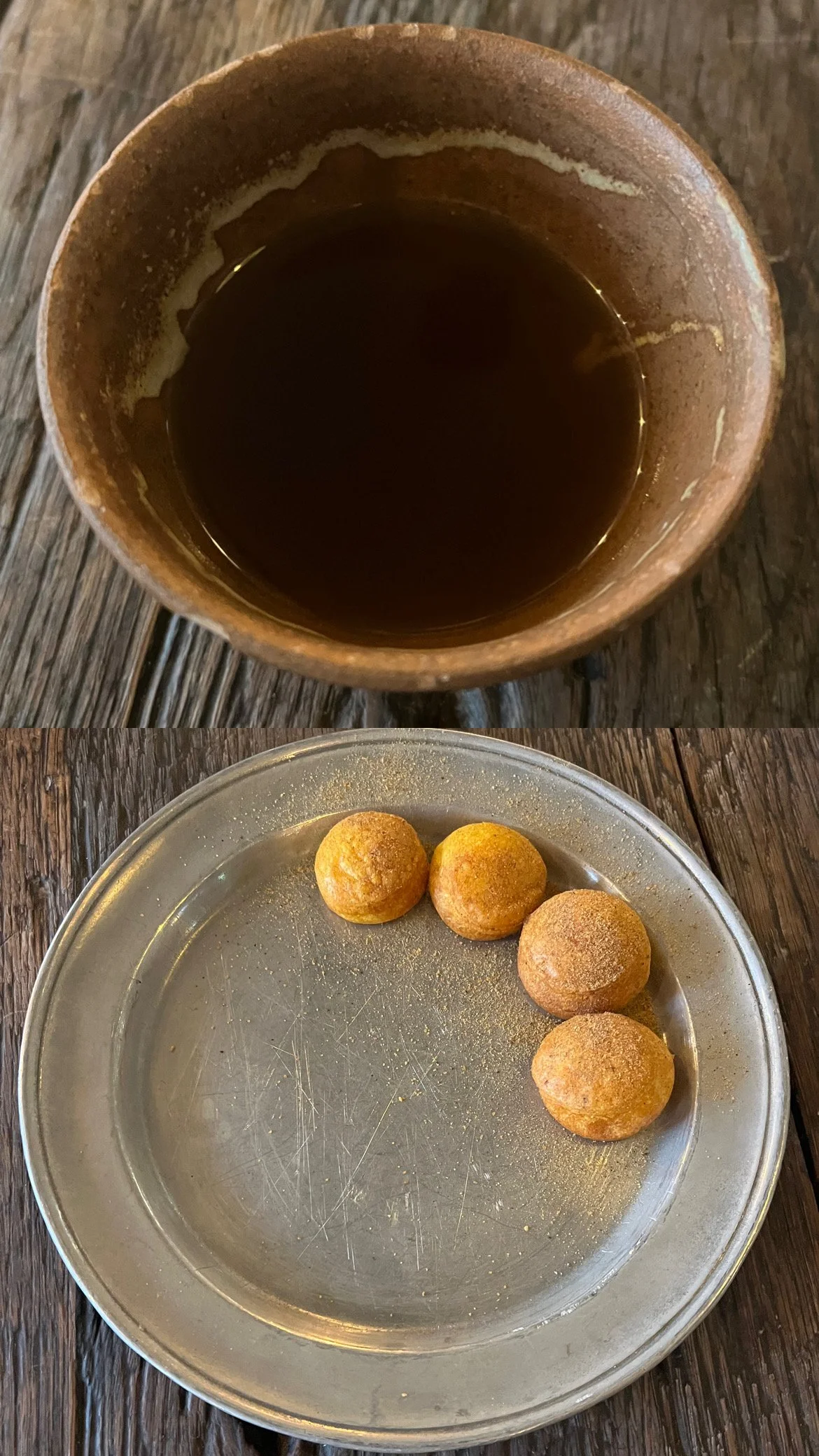
The two amuses bouches were a cup of vegetable and smoked onion stock and four gougères (think light, airy, cheesy puffs) sprinkled with a soft spice mixture.
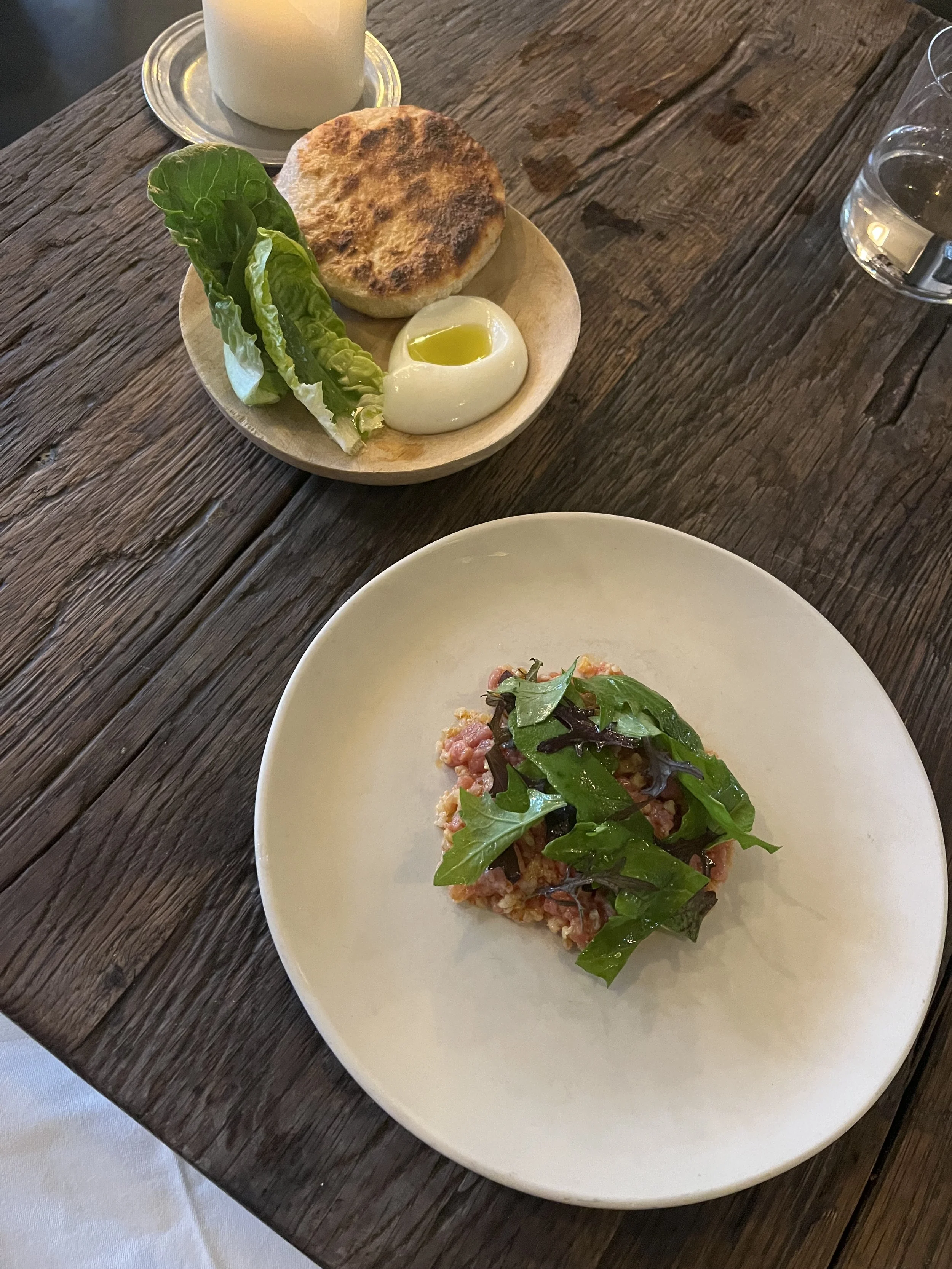
First course: veal tartare, served with a smoked labneh and warm grilled pita. I don’t need to tell you what tartare is, nor should I need to tell you what veal is. I’ve never had veal in raw form, but I loved it. It’s a more delicate taste than the traditional, and more tender. The build-your-own lettuce and pita wraps with the smoked labneh were fun and thoughtful—and more importantly, a really good bite.
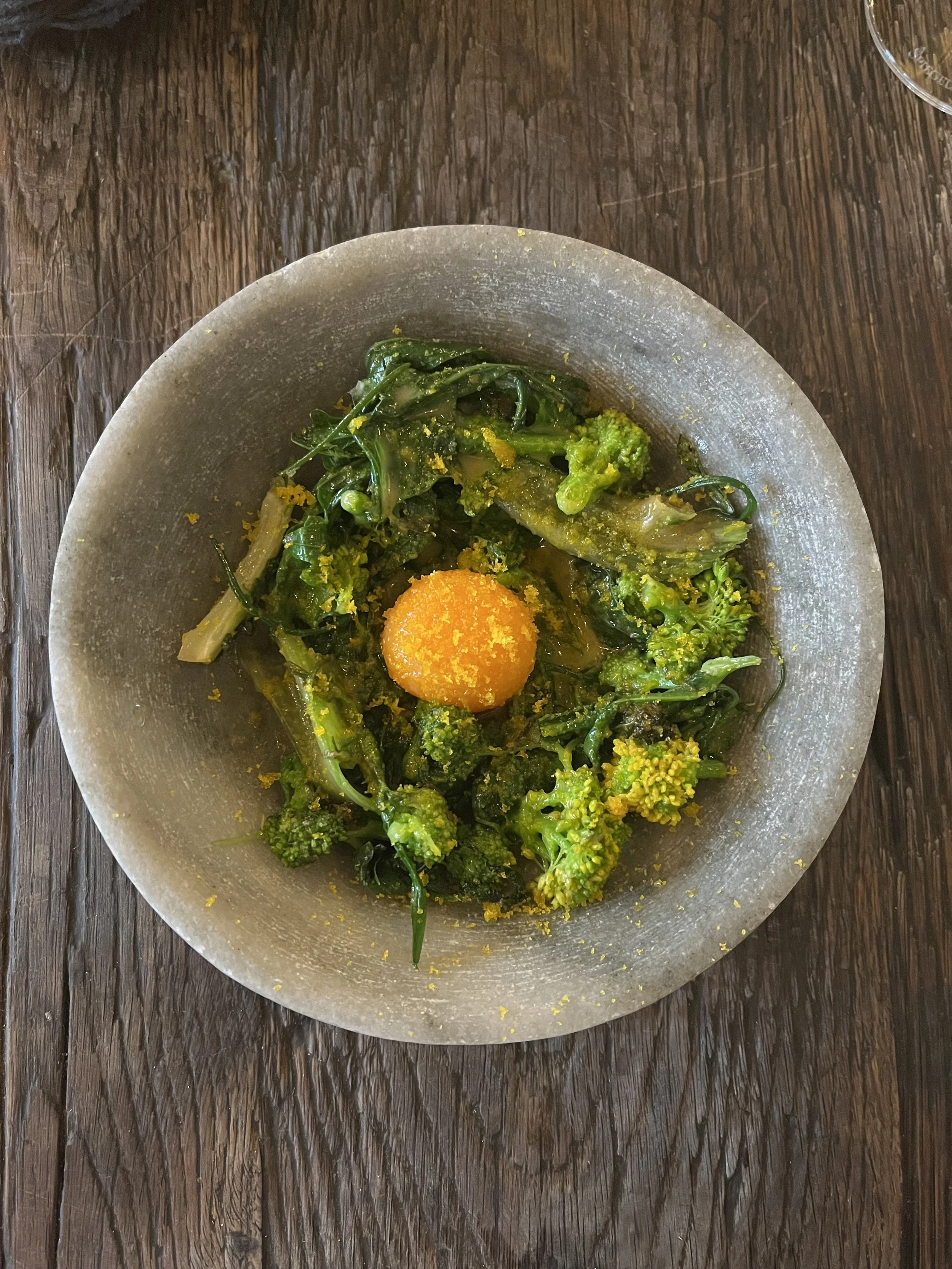
Second course: Greens (with two kinds of broccoli), cooked in a barigoule (white wine sauce), with a confit egg yolk. Greens are hard to cook. Especially in a mix like this. Broccolis cook at different times than other, leafy greens. You can’t overdo it or they lose both color and flavor. At the same time, you don’t want the sauce to completely cover the taste of the greens. I’m telling you that to tell you none of those things were a concern with this dish, and the egg yolk added both flavor and texture to an already delicious dish.
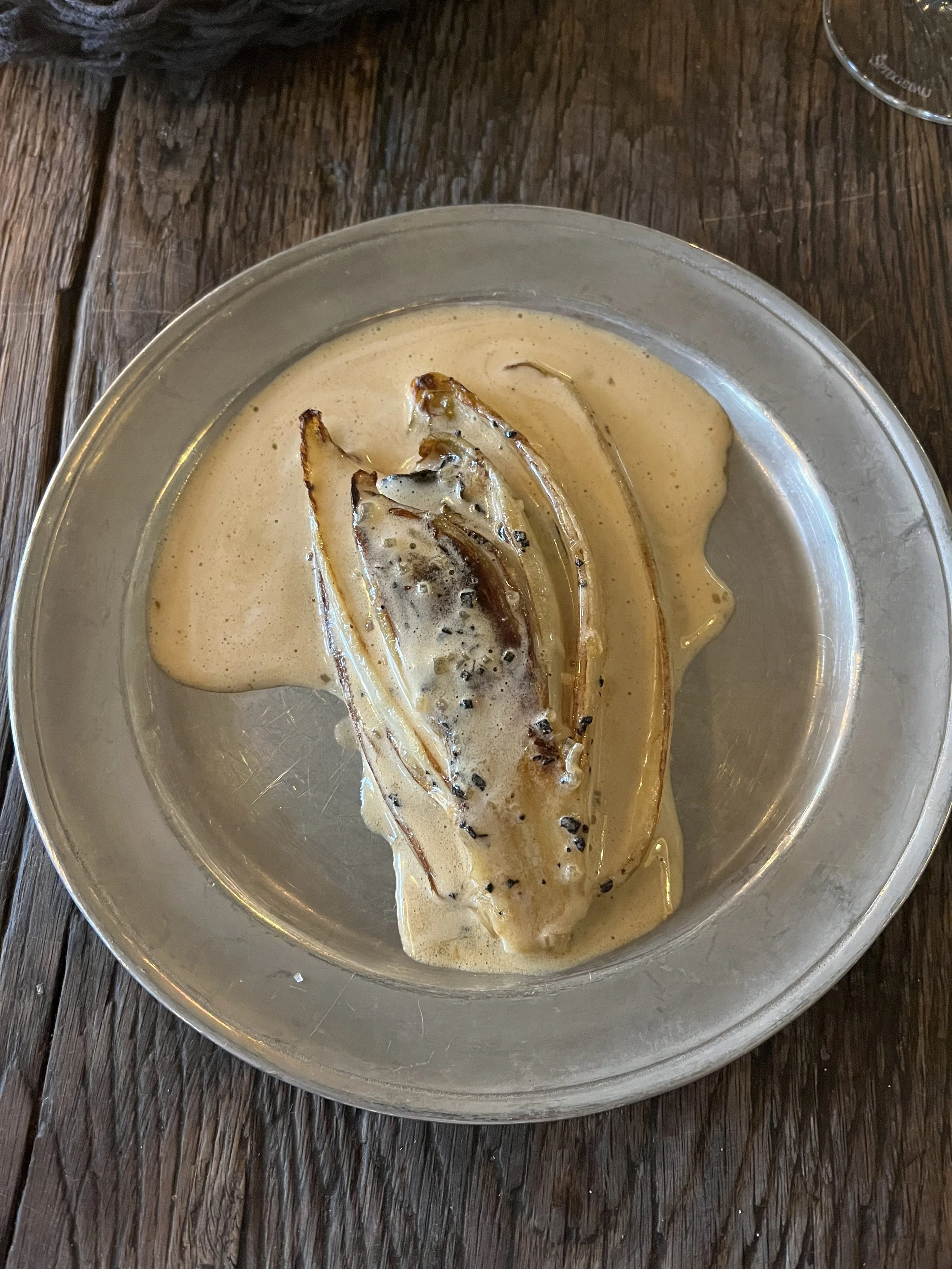
Third course: Confit endive with black truffle, with Sauce Diane. It’s bold to put a big slab of cooked vegetable on a plate and call it a course. This, I would eat every day. I would drink the sauce straight from the pot. Sauce Diane isn’t one of the traditional haute French sauces—some think it’s actually British. It was traditionally served with a kind of steak. It’s made with butter, shallot, cognac, whipped cream—and in this case, more truffle. The endive, cooked as it was, ate like a slightly bitter steak. Trust me: this is not some kind of vegetarian diatribe. This is just good, inventive cooking that changes the way you look at ingredients.
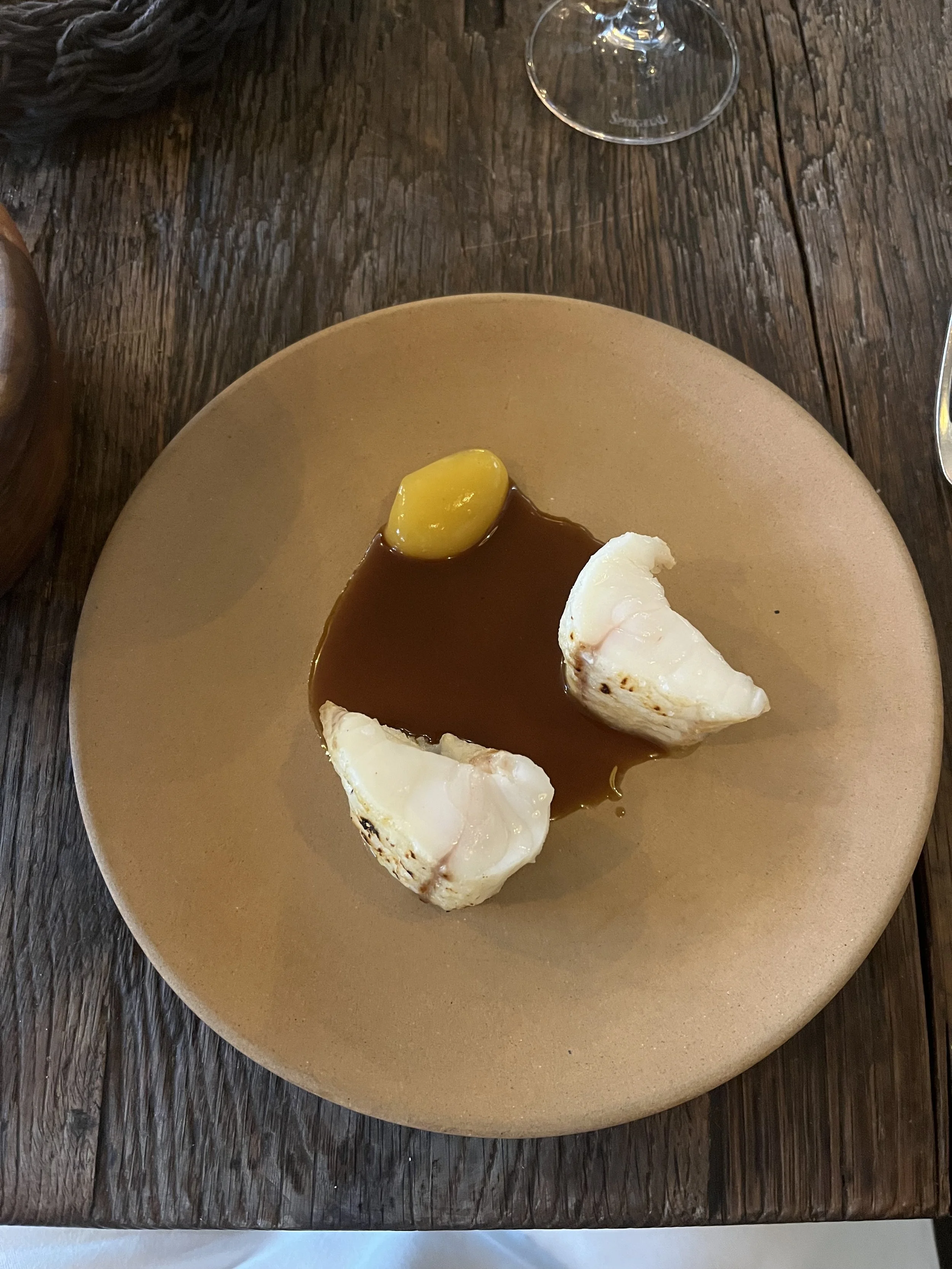
Fourth course: Grilled monkfish with bouillabaisse sauce, and a “potato salad.” Bouillabaisse is a Provençal fish stew, cooked in a rich seafood-based broth, and is usually served in two or three courses. This kind of skipped that part, and served the fish on a plate with the sauce, reduced, alongside a citrus gelée. The side dish, which was technically called a potato salad, was not what most Americans will expect. In fact, I laughed when she told me what it was. This side dish instead was shoestring potatoes and fennel lightly cooked and dressed in a spicy (like, actually spicy, spicy for me) lemon sauce. Individually, delicious. Together? Incredible.
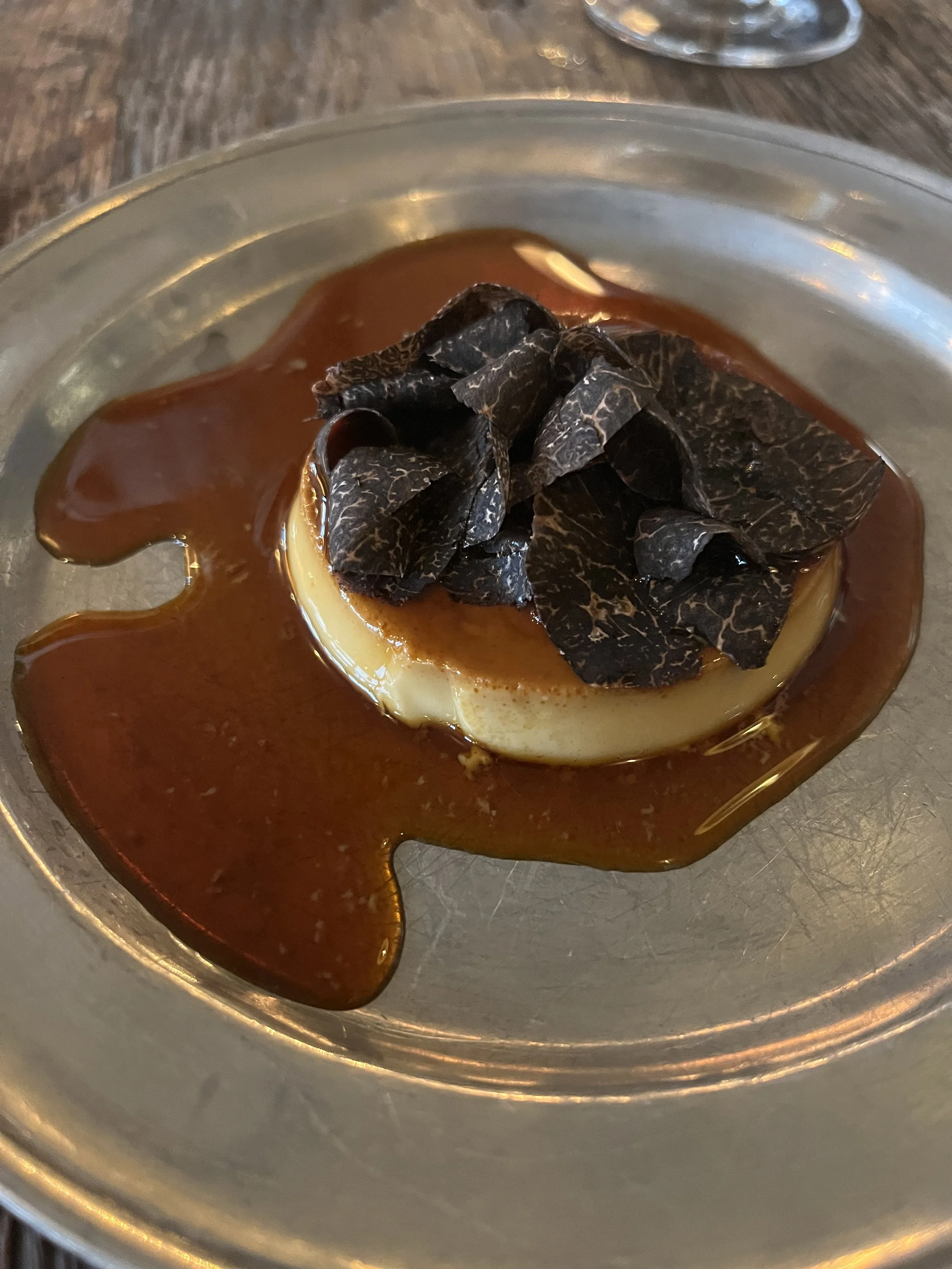
Fifth course: Crème of clover caramel, covered with fresh black truffles. I laughed again when they sat this in front of me. Why not? Why not put truffles on dessert? And I don’t need to tell you that it worked. That incredibly unique, soft umami from the fresh truffle blended right into the not-too-sweet custard of the flan.
Some of my classmates have Michelin-star aspirations. I don’t share in that. At nearly 40, that kind of intensity in my life is behind me. Part of coming to Le Cordon Bleu was to better educate myself on the kitchen so that I could have better, more thoughtful discussions about food, cooking, meal and menu design, and apply those in some way to my life afterwards. Even three months in, I can see the changes in my appreciation for cooking like this. I watched a line cook make a cartouche in real time—it’s a lid made from baking paper often used in French cooking. It allows you to see the cooking better, and creates more control over evaporation when cooking with liquid. And now, I know that. Because I’ve made so many, in the moment, just like she did.
That made this meal all the better.