“Chaud” - Hot
I lost my wedding ring in the daze of a Parisian heat wave.
You know, that can be misinterpreted. Let me try again.
Paris had a “one-in-a-thousand” heat wave. Temps around 32 degrees celsius, which translates to 90 in Fahrenheit. Between that, and not having air conditioning in…uh…anywhere, and being in a kitchen where we regularly have 15 ovens on at 170 degrees (roughly 340 Farenheit), my fingers were swelling like a neanderthal’s. My ring, which I have taken off maybe a handful of times in the last six years, was digging into my finger and rubbing the skin around it raw. I mentioned it to Katy and she said, “just take it off, it’s not worth it.” So I did. I slipped it into my pocket and took some friends to Montparnasse to visit La Grande Epicerie, then we walked to a noodle joint for dinner. Somewhere along the way, I pulled my phone out to check directions. Maybe, subconsciously, I heard the light “tink” of a small piece of metal hitting the sidewalk: my ring being slipped out of my pocket by the phone case and tossed unceremoniously to the Parisian ground. If I did, I didn’t register it, didn’t think, “I should check on that.”
After we took the train back home, I felt for my ring on my finger—something I’ve done three dozen times a day for the last six years—and realized it wasn’t there. I reached into my pocket to slip it back on and…it wasn’t there either. I checked every pocket, three or four times. It was gone. That was it. The ring belongs to Paris, now. Katy assured me we can get another one, identical.

In the thick of the heat, we bought two fans for our little apartment: a small one that sat a few inches from Auggie’s face while he slept, and a taller one that blew in our bedroom at night and the living room during the day. We kept water bottles cold in the fridge and cycled them in and out. We opened windows at night, shut them up during the day, and kept the blackout curtains pulled the entire time. If we went outside, we hid in the shade of the trees in parks and slathered on sunscreen. It turns out that Auggie, bright white and radiant as he is, takes after me and gets a tan even with hefty SPF on him.
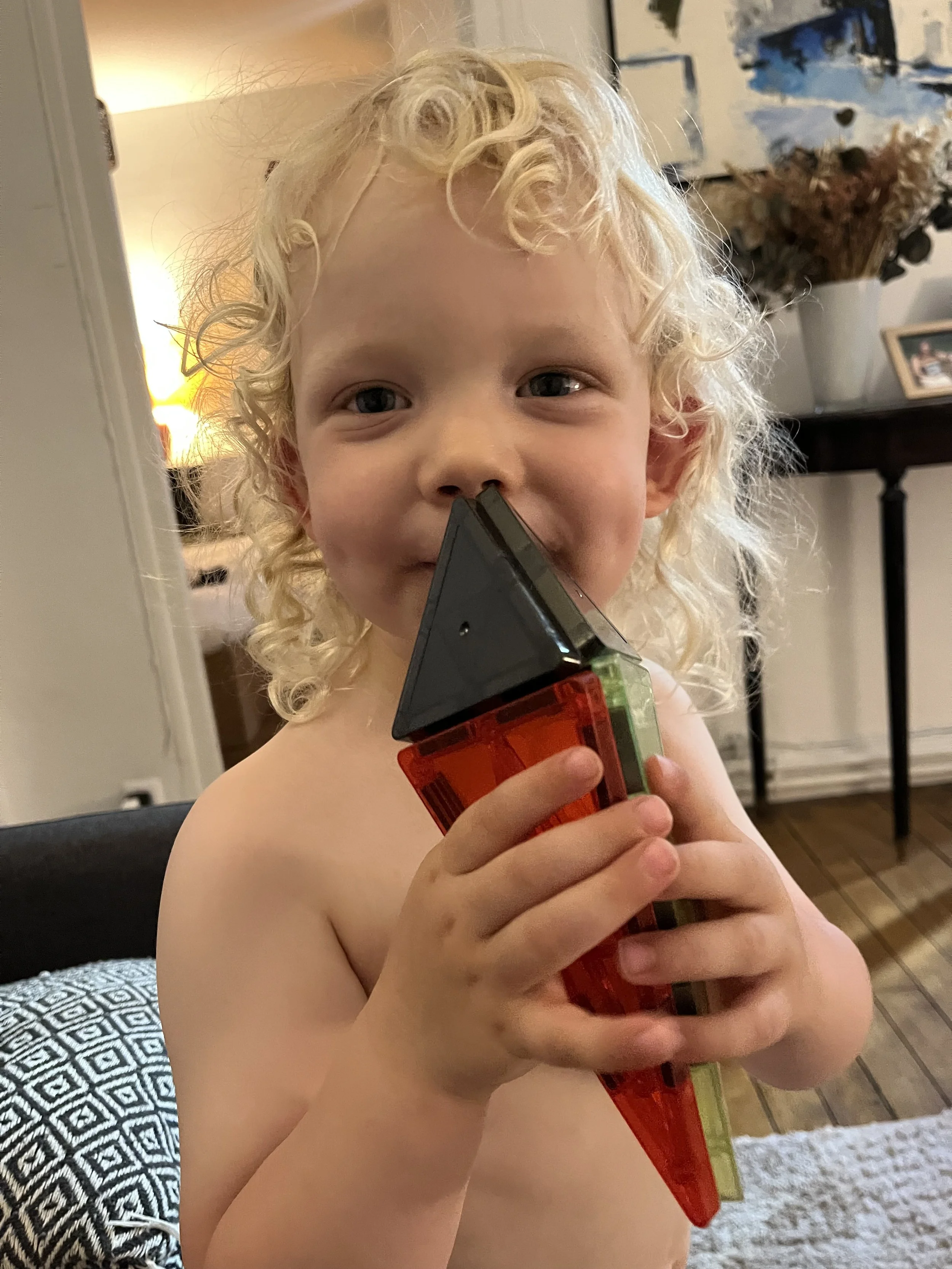
Temps have come back down to normal now. I wore a jacket on my way to class this morning. I’m listening to the rain (and hail?) in the courtyard out our open windows as I write this. But summer is still coming. It’ll get hotter. We’ll probably end up with an air conditioner.
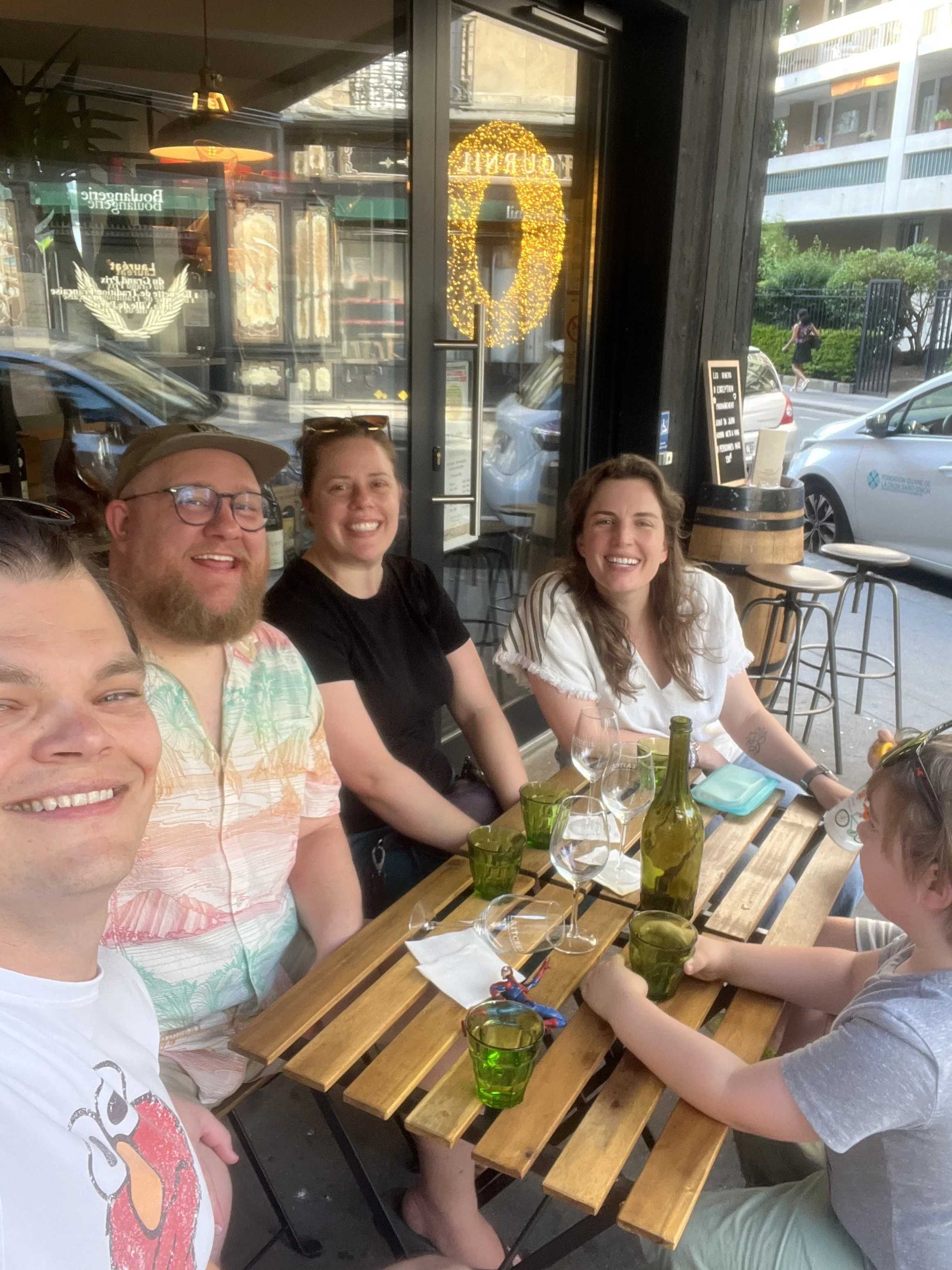
At the time of writing, some friends just departed for London, after spending several days with us. It’s fun getting to show visitors the city we’ve come to love so much—even in a heat wave. On their first night here, we met up in a park where Auggie loves to run and insists I hold his hand while he does it which forces me to run too, then popped into a spot nearby called Laitcru for an apéro of cold, crisp white wine, cheeses, and charcuteries. When you’re jetlagged and maybe a little delirious from lack of sleep and the push-and-pull of a long travel day, there may not be any better welcome to the city.
Thanks to careful forethought, we had early tickets for the Musée d’Orsay and got to walk around the Impressionists one morning while savoring some air conditioning—the Monets, van Goghs, Sisleys, Pissaros, Gaugins, Degas. And we saw a new exhibit called Renoir et l’amour (Renoir and love). Being with visitors also gave us the chance to see things we hadn’t on our last visit—like a scale model of the city which you can walk over and look down upon for a bird’s eye view of the city. We saw Manet’s Olympia, and a really haunting one called l’Enigme by Gustave Doré painted in a grey palette, depicting a sphinx looking sadly at a winged woman seeking answers. It was torturous, and beautiful.
Katy and I have begun to find a few places we would probably call “our favorites.” We stopped by one after we left the museum. Poget & De Witte is a huîtrerie (oyster bar). They serve bottles of affordable champagne and giant plates of oysters, ranging from salty to creamy, as well as a few shrimp and fish carpaccios thrown in for good measure.
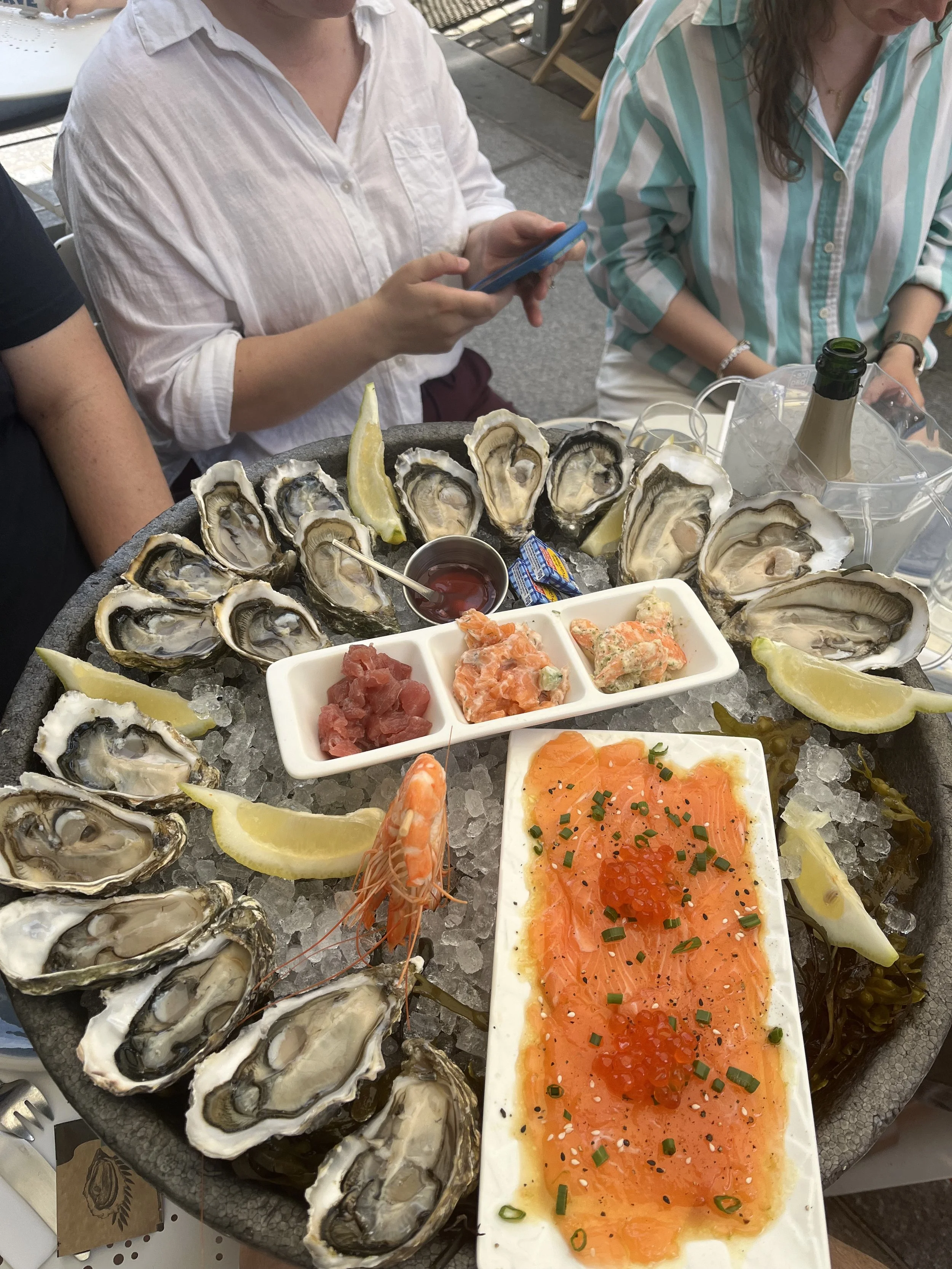
To me, there are few foods better than an oyster. In its versatility, in its simplicity, in its range. It can (and should!) be enjoyed raw, completely free of accoutrements, or it can be jazzed up with hot sauce or mignonette. They can be briefly cooked until warm, baked with sabayon. They can be breaded and deep fried. Grilled, served Rockefeller, in chowder. I’ve had them as small as Auggie’s clenched fist and as large as the palm of my hand—and I have big hands. And on a day as hot as this one, a big plate of iced-down oysters and bottle of bubbles under an awning on Île Saint Louis was exactly what all of us needed.
A brief aside, which you might find amusing. My family has an old recipe for oysters, and it’s one I’ve never understood. The oysters are, in theory, fried. But they’re not really fried oysters. Bear with me. From what I understand they’re an old bar snack from when my grandfather worked in the kitchen of a spot in southern Indiana. They’re made with saltine crackers, egg, and canned oysters. You smash the saltines until they’re crumbs—ok, simple enough. You whisk the egg, this is your binder. You open the can of oysters (which even makes my stomach turn a bit as I’m writing), pour a dab of the oyster liquor into the egg, and reserve the oysters.
As you might imagine, you take an oyster, dip it in the egg, and then pack saltine crumbs around it. That, in and of itself, doesn’t sound bad when fried, does it? Mais non, we’re not done. You continue packing saltine crumbs around it, dipping in egg to create more binder so you can add more, and more, and more. The final result resembles a small football, like something Auggie might play with, of saltines surrounding a little canned oyster. They’re fried virtually forever because they have to be in order to fry all of the cracker and egg, and that poor little oyster doesn’t have any chance of seeing the oil so it basically remains raw. You eat them on paper plates, and dip them in ketchup. There are no sides, no herbs, nothing fresh to brighten them up. Lemon? How dare you suggest it.
(My mom and aunt don’t like oysters, even in the best of forms [which is literally any form but what I just described]. So when we all got together and ate them, rather than making literallyanything else, they just made more of those, sans oyster. You read that right: they got fried saltines for dinner.)
As a bar snack…maybe I get it. All those saltines have to a) sober people up and b) make people crave more beer to counter the salt. Maybe I’ll culinary-school that recipe up this winter when my friends and I go deer hunting. It can’t be hard.
While at the oyster bar, something fun happened. We sat around the table and the two kids didn’t really have anything to eat. Neither wanted oysters, and I understand that. The last time we visited, the woman who seems to run the joint (both she and the man behind the counter told me the other one was the “chef” which means boss) asked if we wanted a small “kid’s meal,” either fried fish or a burger, with fries from the restaurant across the street. I caught her and said, in French, “The last time we were here, you ordered fish and fries for him. Is that possible again today?” She answered, asked what we wanted, and away she went. I reached for another oyster and Katy said, “Do you realize you just had an entire conversation in French, and you conjugated all the verbs correctly?”
I looked at her. “No…she switched to English.” My friend Ryan, sitting across from me and who does not speak French, assured me she did not switch to English. In my head, I completely understood what she said. Don’t mistake: my French is still abhorrent. But understanding other people has been the largest hurdle in trying to learn. I can read it, sort-of speak it. I’m due to be humbled again quickly, so look for an embarrassing story next week.
Like I wrote about Père Lachaise Cemetery, Paris and many European cities have a long history of dedicating space to the dead. After all, there have been a lot of people before us who have come and gone. Some don’t have the luxury of being as nice as Père Lachaise—they’re a bit less beautiful. At least, in their own way. On the day after the heat broke, my friends and I visited Paris’s Catacombs.
The Catacombs were originally limestone quarries under the city. It’s where a lot of the rock which makes up the iconic Parisian architecture came from. Eventually, the city was left with these large caverns deep underground and, coincidentally, a large number of bodies which weren’t quite-as-far underground. When presented with such a conundrum, they did what felt natural: turn the caverns into an ossuary.
Bodies were transferred from overflowing cemeteries starting in around 1785. They currently house about six million remains. In typical French fashion, they didn’t just inter the bodies underground. Au contraire: they were both efficient and beautiful in their storage. Similar bones were stacked together—femurs with femurs, skulls with skulls—and in some cases they created designs out of them. There are carved inscriptions from philosophers and poets throughout the winding corridors. As you take the step from the caverns into the ossuary, a sign above reads: Arrete, c'est ici l'empire de la mort (Stop, here is the empire of death). Beautiful, dramatic, and dark. Like I said: very French.

In college, I took a class on Puritan literature, and looking back I’m not sure why I thought that was a good idea. But one thing in particular stuck with me. Our professor told us that most Puritan books but especially children’s books included a phrase in Latin, one you may have heard or read before: Memento Mori. There are several translations, but it boils down to: “Remember that you will die.” And indeed, it comes for all of us.
In these brilliant monuments to the human condition, how can we not remember the end? How could I, walking among the bones of millions who walked before me, not remember my own son and not cry, standing 131 steps below the city? Of my father? The tears and chills spread through me and I let them, briefly.
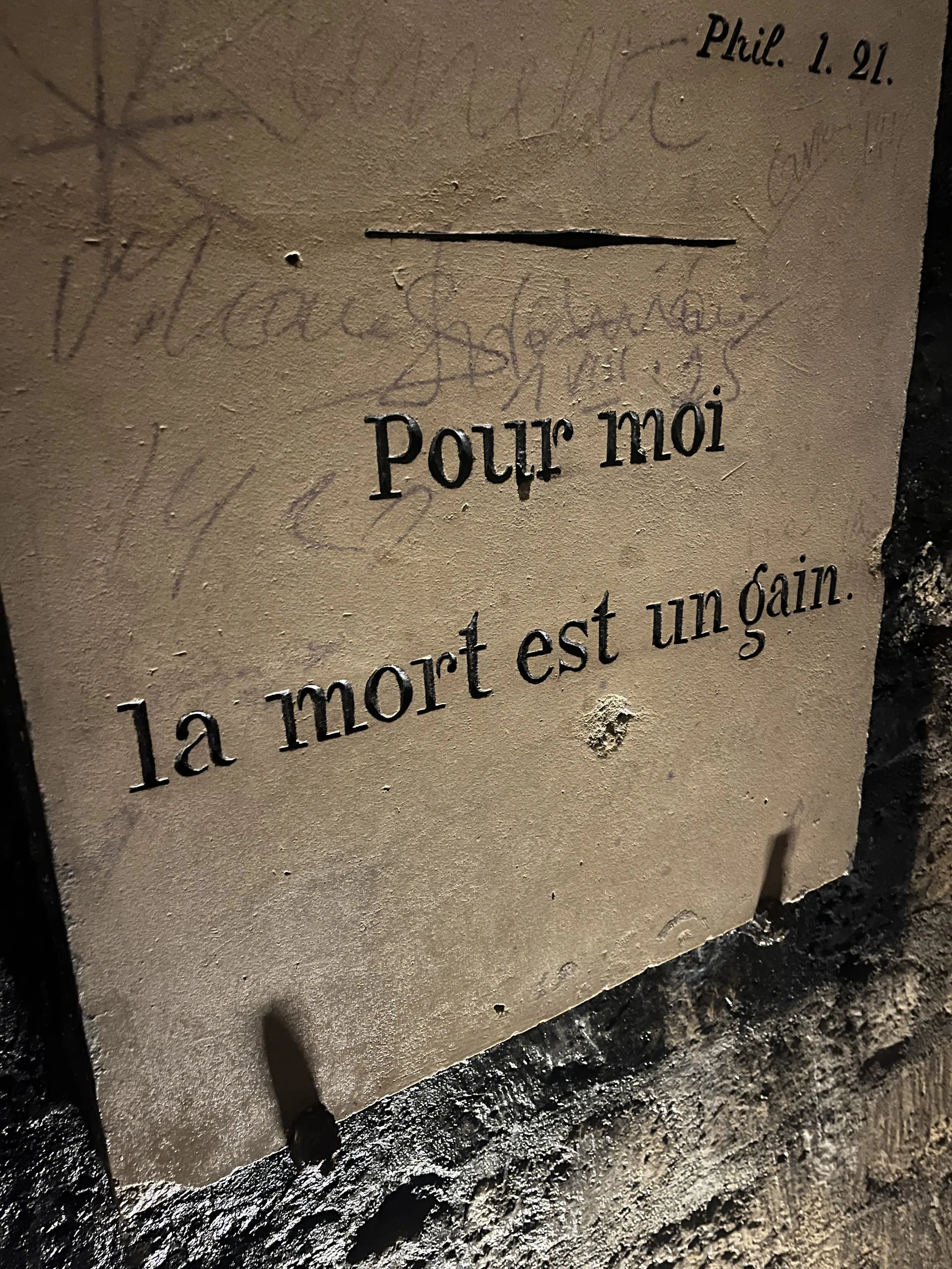
When you come to Paris, you might like The Catacombs. Like I did, like Ryan and his family did. I might recommend you go, but would send you with warning. There are real bones of real humans, and a lot of you had issue with the plate of pigeon I shared last time, so consider that. It’s also a bit claustrophobic. I’m 6’3” (190,5 cm) and walked stoop-shouldered most of the way—and still bumped my head a couple times. And it’s not for the faint of heart. Especially not the 112-step spiral staircase at the end to get out.
I’ve been reading a book called The Traveling Feast by Rick Bass, given to me by my friend Carl as a going-away gift. The gist is Rick travels the country visiting some of his writing heroes, people like Amy Hempel and Denis Johnson and David Sedaris and Joyce Carol Oates. And he cooks a meal for them, just to spend the time together, learn more from them, soak in the beauty of stories that come out in moments of shared eating.
That concept is beautiful. It’s got me wondering who I might cook for in a scenario like this, what I might write about those visits. But as we’ve had people visiting, I realize in some way I’m doing something similar: putting together meals for people who we love and who love us, and sharing a meal together as thanks. For everything.
Bass focuses a bit more on the person, the hero, on the lessons he learned from them and the way they taught him. Naturally, mine might be more about the food, why I’m making what I make, and the conversation surrounding the meal. Maybe mine would lean a bit more toward Jim Harrison’s (who is not our Harrison’s namesake, but not an unhappy coincidence) food writing, which in my opinion was prolific. I encourage you to read A Really Big Lunch, which I couldn’t find a free copy of online, but here’s a quote from an interview with Jim to give you an idea of what it’s like:
“To that end, Harrison had, in just over 24 hours, consumed all manner of organs from a small zoo of fauna—poultry and crayfish soup; tartines of foie gras, truffles, and lard; another soup of cucumbers and squab, served with cock fritters; a crayfish bisque; oysters on toast; jellied poultry loaf; Baltic herring; tart of calf’s brains; sea urchin omelet; fillet of sole; monkfish livers; pike and parsley; oven-glazed brill served with fresh cream, anchovies, and roasted currents; another stew of suckling pig, slow-cooked in a red-wine sauce thickened with its own blood, onions, and bacon; a warm terrine of hare with preserved plums; a poached eel with chicken wing tips and testicles in a pool of tarragon butter; glazed partridge breasts; a savory of eggs poached in Chimay ale; and then a mille-feuille of puff pastry sandwiches with sardines and leeks; bites of stuffed ravioli; more poached eggs; squab hearts; a “light” stew of veal breast in a puree of ham and oysters; gratin of beef cheeks; more squab (“spit-roasted”); wild duck with black olives and orange zest, a buisson (bush) of more crayfish with little slabs of grilled goose liver; a terrine of the tips of calves’ ears; hare cooked in port wine inside a calf’s bladder—plus crispy breaded asparagus, a sponge cake with fruit preserves, cucumbers stewed in wine, another few rounds of salads, cream of grilled pistachios, meringues, macaroons, and chocolate cigarettes. The night concluded with an entire additional dessert course in the restaurant’s nearby salon, followed by 80-year-old brandy and some Havana Churchills.”
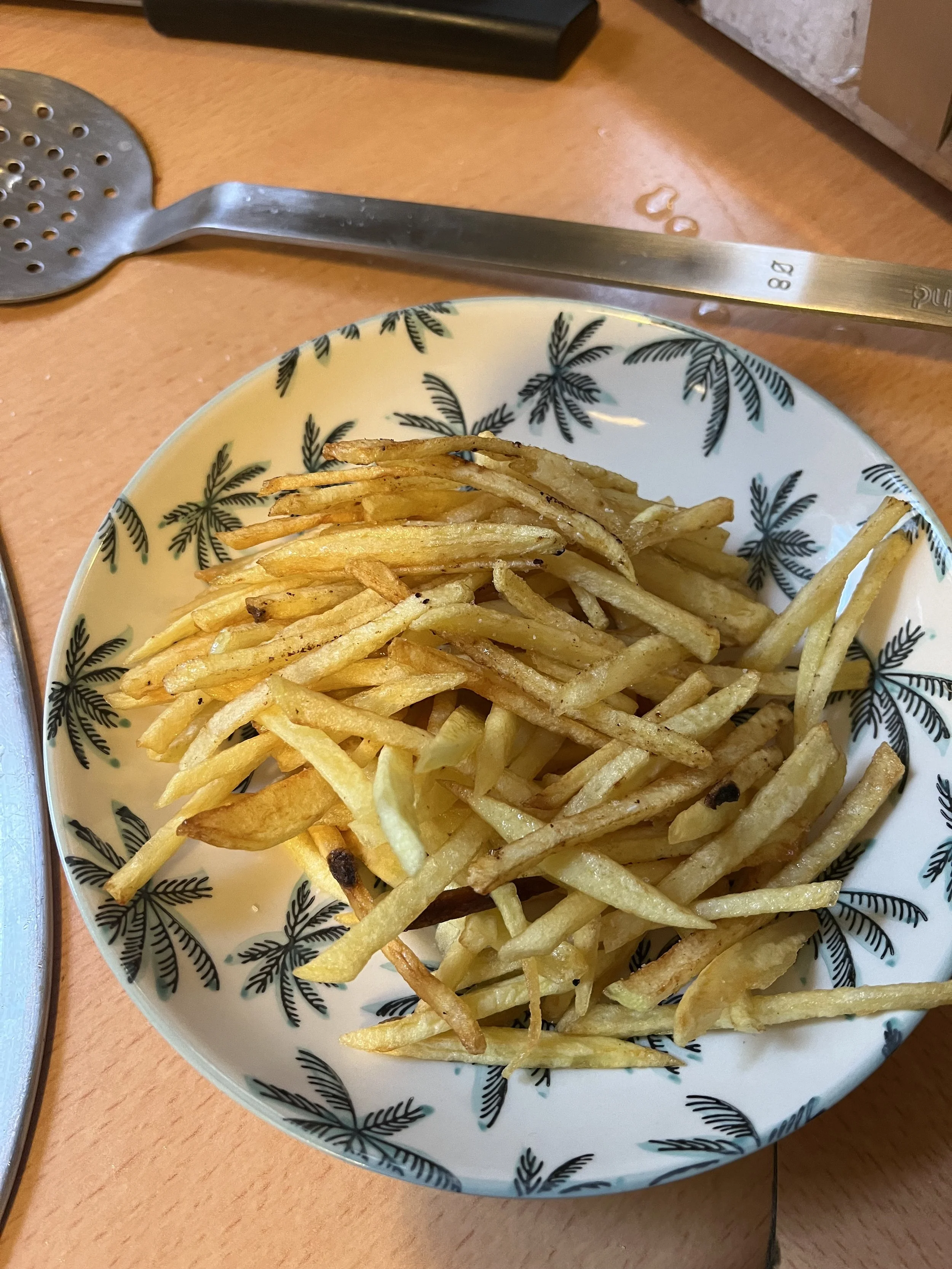
So maybe a blend of that, albeit a smidge less gluttonous, with Bass’s insight. As we’ve had guests, I’ve had the opportunity to cook for them. For Katy’s aunt and uncle, I made faux filet de bœuf with sauce poivre (steak with pepper sauce), asparagus and artichoke with sabayon, and pommes de terre dauphinoise (what we might call “potatoes au gratin” at home, and at which the French would loudly scoff). For Ryan and his wife and son, I made magret de canard à l’orange (duck breast with orange sauce), œufs mayonnaise (think French deviled eggs), asparagus with hollandaise, and a simple salad with shallot vinaigrette. With Katy’s friends/co-workers who are visiting, I made roasted chicken, tian de legumes (the actual name of the “ratatouille” dish from the Pixar movie; ratatouille is a stew), and handcut duck fat frites.
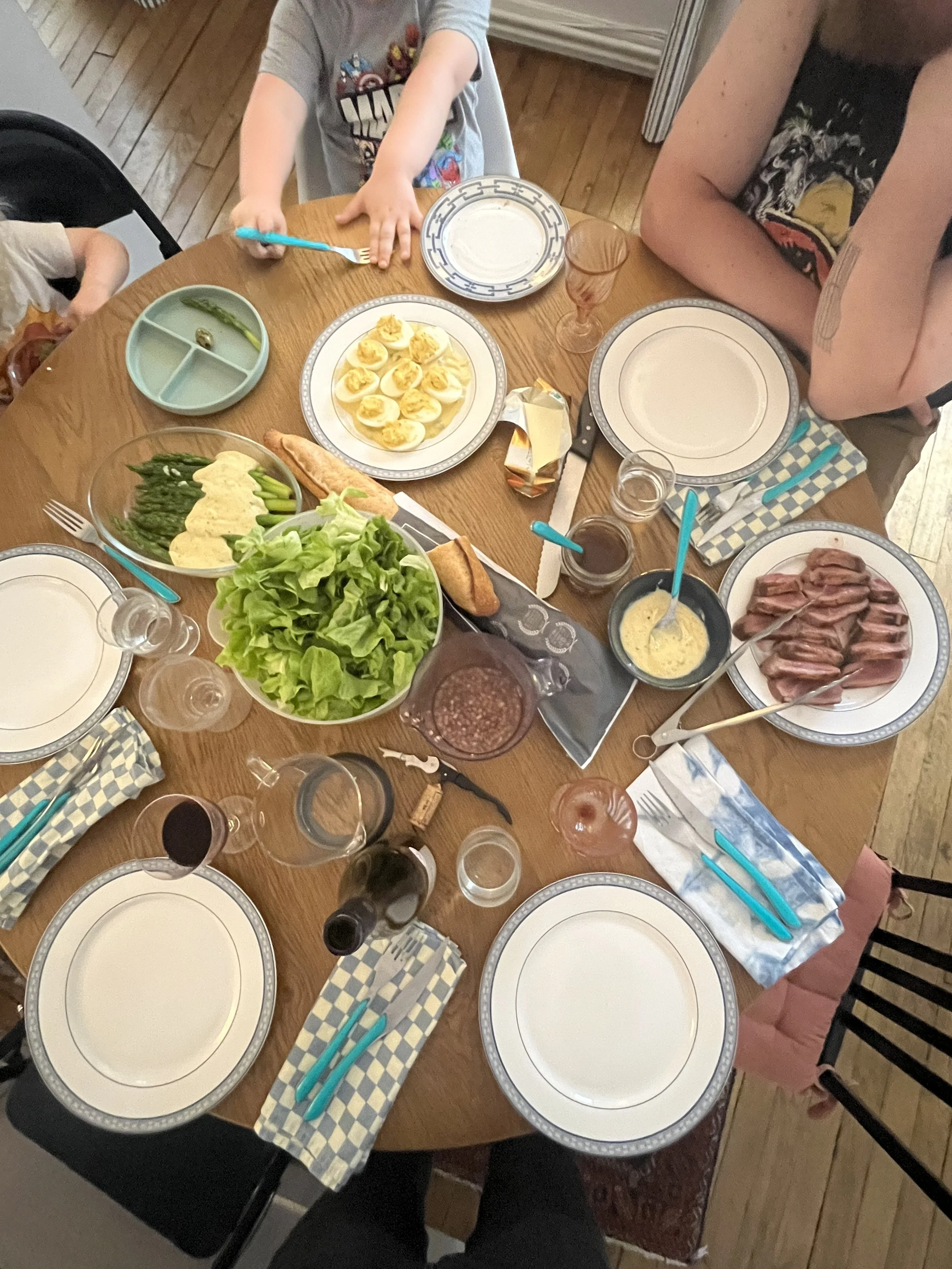
There are stories behind all of these dishes. And perhaps I’m focusing too much on the food and not enough about the company. But by pouring my heart into these, I’m doing what I’ve come to love so much. Maybe a nice writing exercise. Maybe just a nice way to show people I care about them.
When we arrived here just over five months ago, Auggie barely spoke. He was timid, maybe shy. He fell a lot just walking. Katy and I describe him not unkindly as our scaredy cat. While Harrison often climbed tall chairs and stood recklessly on an arm for a better view out of a window, or clambered right the to top of his Pikler climbing triangle, August is more measured. He likes to keep both feet (and sometimes his hands and knees) firmly on the ground.
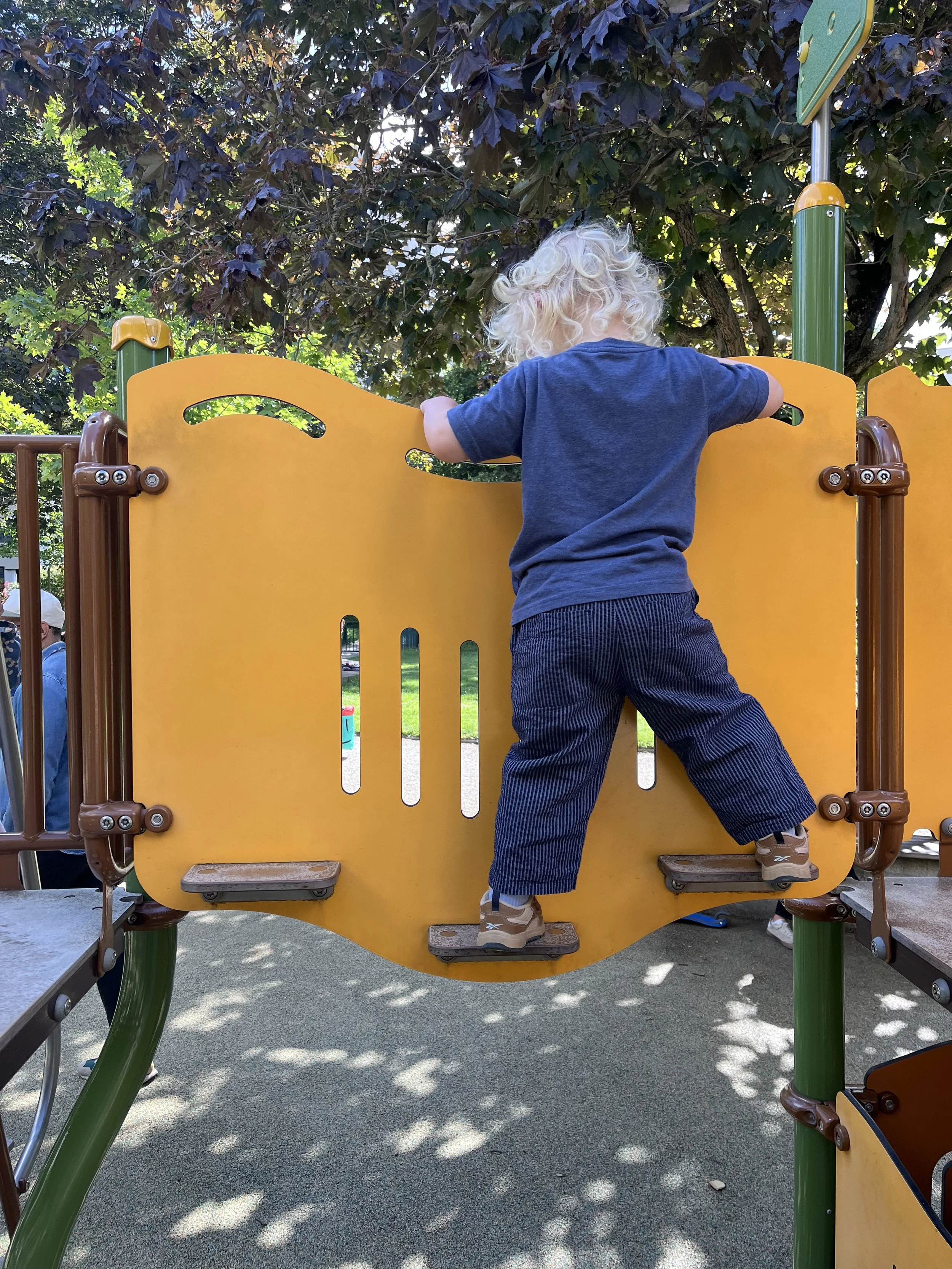
That has all changed. Our opinionated little boy has started to tackle playground equipment he wouldn’t think to touch even two months ago. Recently, he navigated a vertical wall with three footholds completely by himself, back and forth and back and forth, like some kind of ninja. He makes friends with kids who don’t understand him and whom he doesn’t understand, playing whatever communal made up games they can. Laughter is universal.
He now calls me Chef Daddy every time he sees me in an apron. I made a noodle stir fry the other night, and he kept saying how hungry he was for pasta. When I put it in front of him, he said, “Oh, this not pasta. Just noodles. Just noodles.” And ate it up anyway. My own little food critic, right here in the apartment.
Like many kids, I believe, he’s also inquisitive to the point of madness. He’ll point to every illustration in a book and say, “What’s that car doing?” “What’s that train doing?” “What’s that apple doing?” “What’s that police doing?” And best of all, “What are YOU doing?” I try my best to come up with funny scenarios for what these inanimate objects could possibly be up to. But it’s gotten to the point that I’ve begged him, sincerely, to tell me what the things are doing. To use his imagination. Please. Please.
We went back to the book and made it through two pages before he said, “Daddy, what’s that—” and stopped himself short. Looked at me and said, “uhhhh, Daddy, that sign sayin’ STOP.” You’re so right, son, in so many ways.