"Le Processus" - The Process
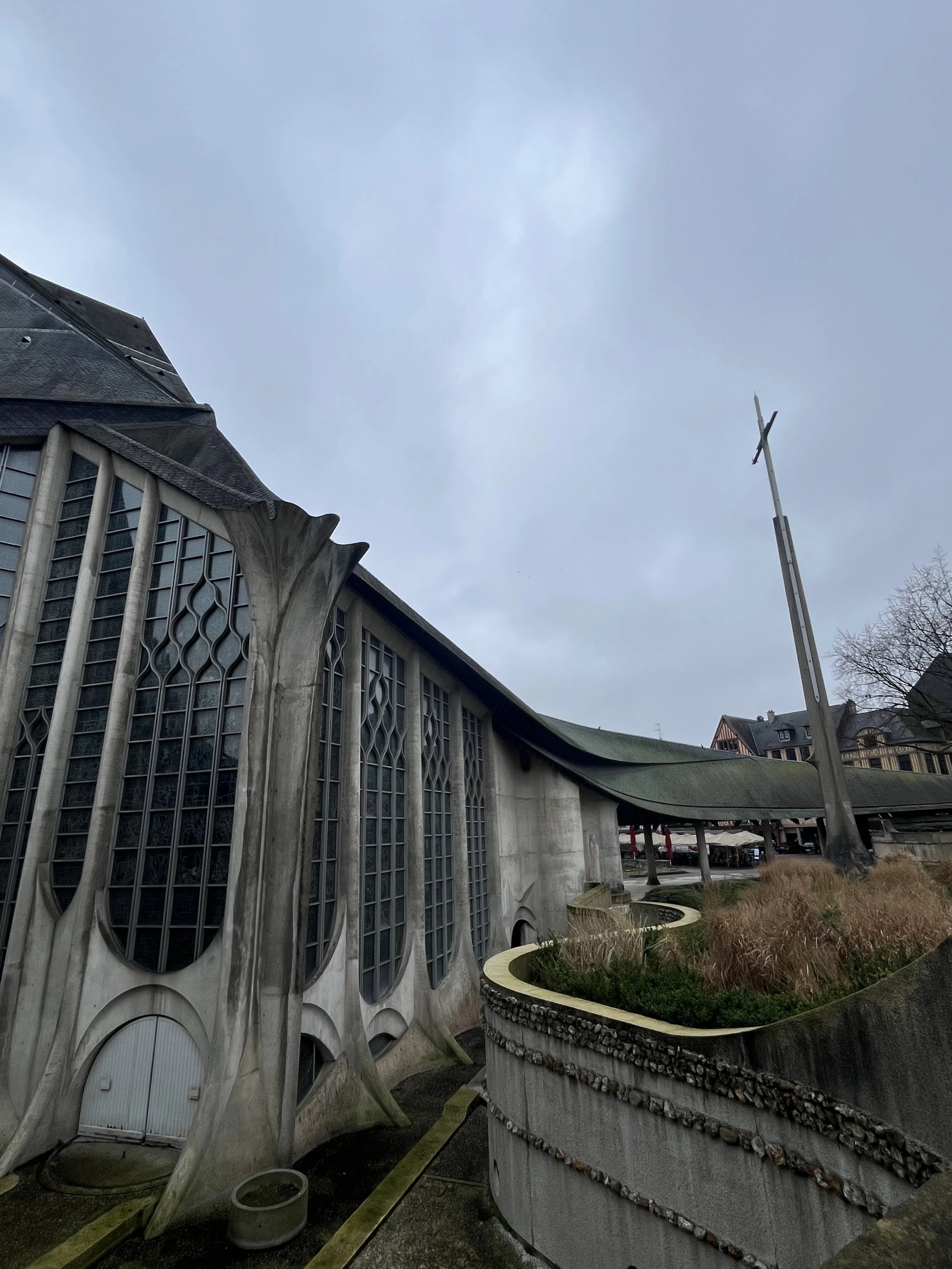
I’m writing from the third floor apartment of an Airbnb in Rouen, Normandy. LCB gave us a week off from class, so Katy, Auggie and I took the opportunity to explore more of the country. If you’re at all read up on your French, Catholic, or history as told by Wishbone on PBS, you’ll know that Rouen is where Joan of Arc was burned at the stake in 1431 at the age of 19. That little moment in history is memorialized roughly 250 meters from our apartment, outside L’Eglise Jeanne d’Arc, with a very tall spire topped by a cross. The church itself was built just in the 1970s, and is full of stained glass and waving, arcing wood ceilings. I longed to hear the organ, but it’s a Friday.
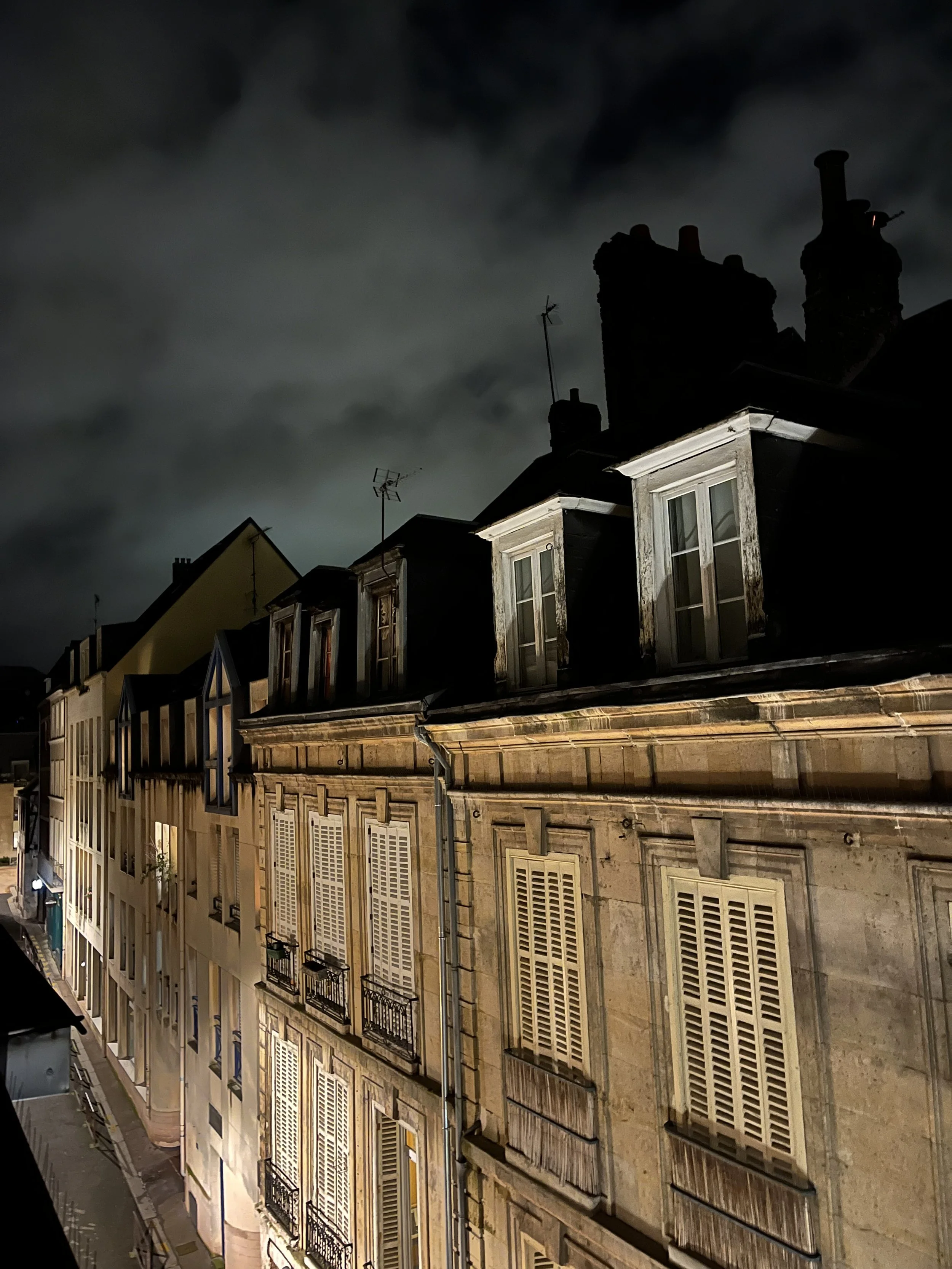
Looking out our window, I can see classic French rooftops stretching across the village. There’s a soft light in a window across the street, with what looks like a couple of jars or vials sitting in front of it. There’s something about it that speaks to me as a writer, some kind of inspiration and romanticism. But Rouen has a much different vibe than Paris: there’s more punk, more grit. There’s less casual grace than you find in the capital, and maybe a bit more of the classic brashness you’ve learned to expect from the French.
It’s refreshing.
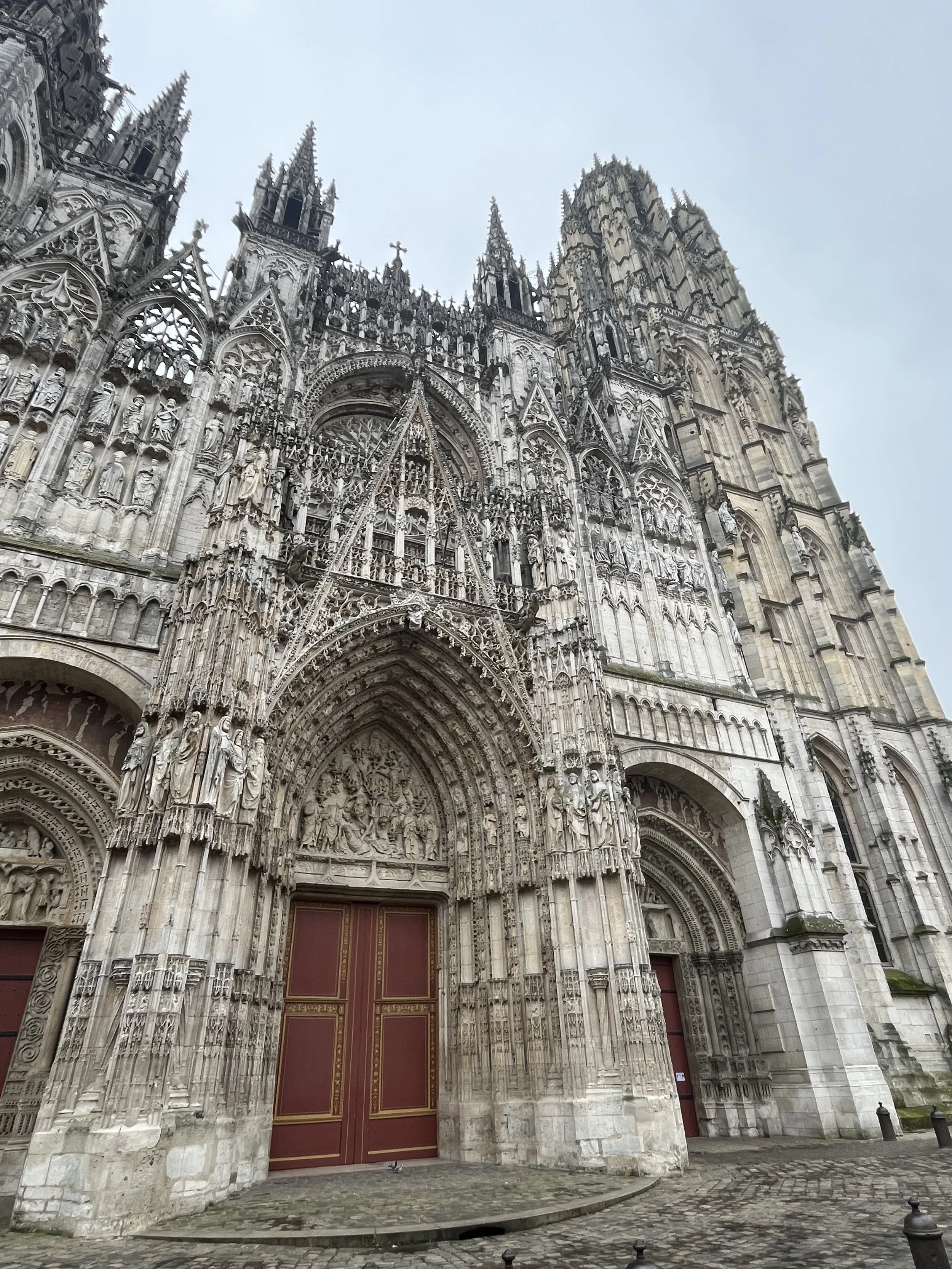
Across town there’s a gothic cathedral, La Cathedral Notre-Dame de Rouen. Its history is a little fuzzy—it was built and added onto and rebuilt over the course of 800 years—but here’s the gist. The groundbreaking occurred in 1030. TEN-THIRTY. It was consecrated a scant thirty-three years later in the presence of William the Conqueror. It was completed, technically, in 1880. It has three spires, each of which is designed in a different style, which of course will happen when you take over 800 years to build something. Trends come and go, after all.
There’s a very famous series of paintings by Claude Monet featuring the cathedral in different lighting. Have a look. Rouen is also the birthplace of Marcel Duchamp, another noteworthy artist, and creator of the Dadaist icon “Fountain,” one of the few remaining replicas of which we were fortunate to see at the Tate in London a couple of years ago.
While we’re on Monet: we rented a car and road-tripped north to a small sea town called Etretat. Along the coast there are dramatic white cliffs which Monet painted. During the roughly one hour in the car, the weather shifted from bright blue skies, to sleet, to snow, and back again, mixing at various points. Etretat, thankfully, was quite nice, but so very windy. We trekked up to the top of one set of cliffs—me lugging Auggie, Katy lugging his stroller—and got a little windburned. We ate at The Oyster Club: two dozen incredibly fat and salty oysters. Oysters rank very, very highly on my list of favorite foods. I find something beautiful in that they don’t need to be cooked or altered in any way to be delicious.
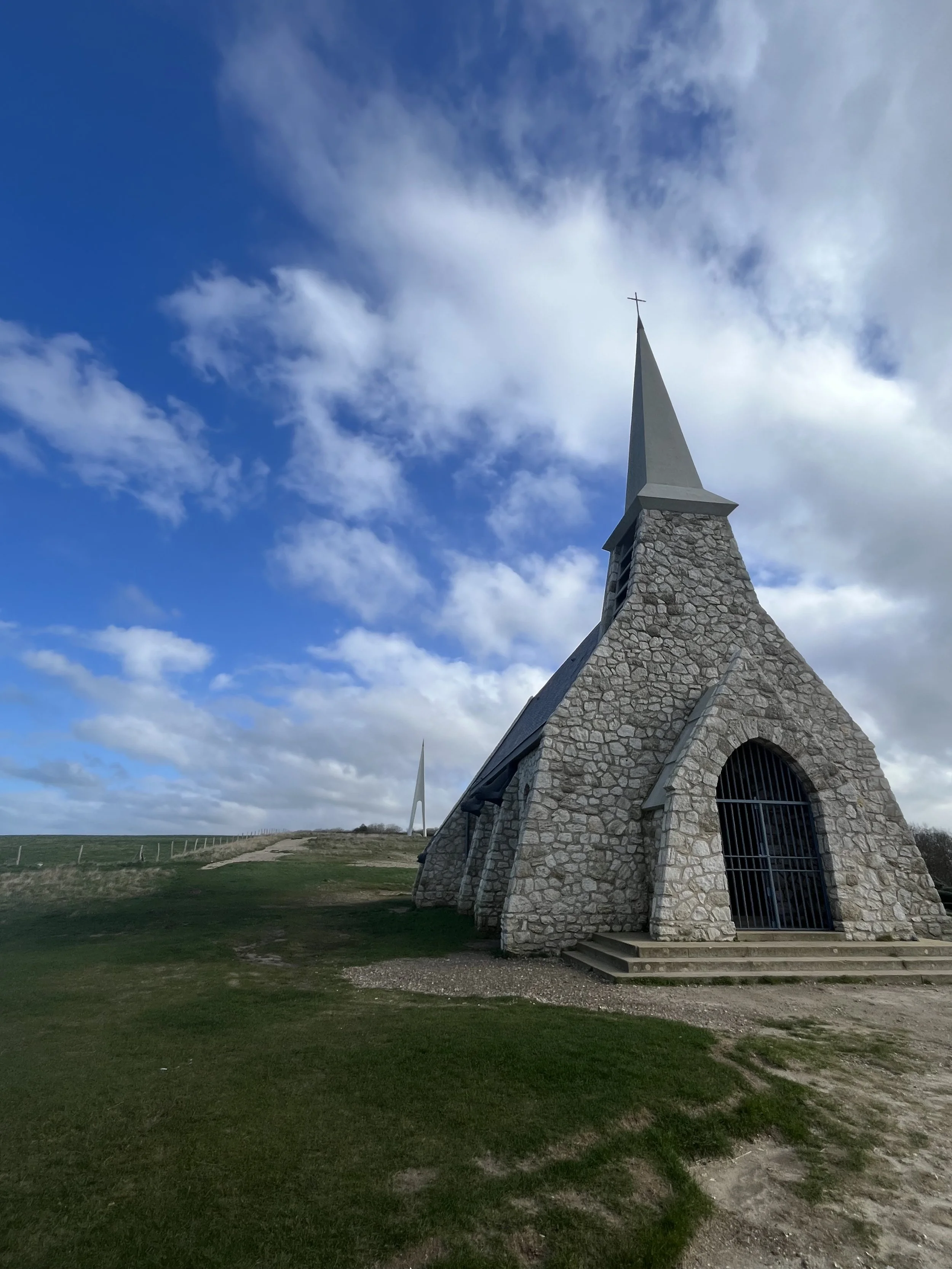
Post-lunch, we let the wind beat us down a bit more, before Katy and Auggie needed to seek refuge in the car. I hiked up the other, much steeper side of the valley to a small church, Chapelle Notre-Dame de la Garde. The church was built originally in 1854 by-sailors-for-sailors—it has gargoyles with fish heads. Of course, this is Normandy we’re talking about, and the original was destroyed during the war in 1942, only to be rebuilt in the 1950s. It sits perched high up, overlooking both the village and the English Channel, stalwart and stoic.
We intended to take the car to Omaha Beach and Bayeaux the next day, but a daylong blanket of rain changed our plans. Instead, we spent more time in the museums of Rouen, with Monet and Alfred Sisely.
Rouen is, conveniently, a UNESCO creative city for gastronomy. One of only 56 or so in the world. Twist my arm. One of many driving dishes behind that accolade is probably canard au sang, or pressed duck, which is a specialty of the region. It involves partially roasting a duck before removing its breasts and legs, and then placing the remainder (meat, bones, organs, and all) into a specially designed press with a twist crank which extracts the blood, marrow, and other juices. The pressings are then reduced and cooked with the duck’s liver, cognac, and of course, butter, to create a luxurious, velvety sauce. More on this below.
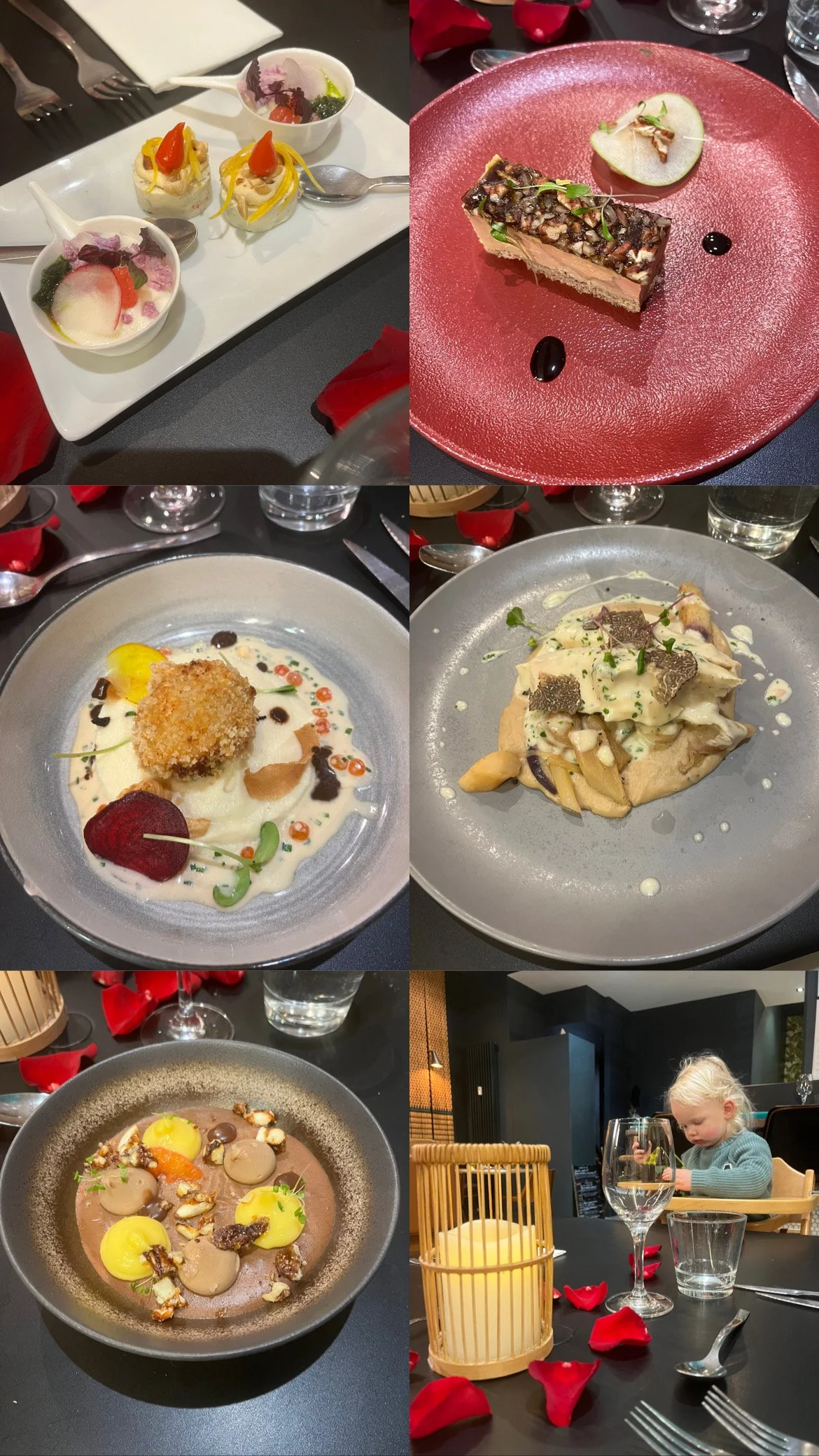
I think it’s funny that, while we live in Paris, the city of love, we left town during Valentine’s Day. We had reservations at a restaurant called In Situ, which had a special Valentine’s Day pre-fixe menu. In the states, those menus tend to feel a little bland to me. Often, they’re catering to people who may never visit the restaurant at any other time—they’re there because it’s “nice” and they’re out for a treat. That’s fine, make your money. My point is that in France, that’s not the case. The menu at In Situ was both inspired and creative. Katy even called it the favorite meal she’s had since being in France. That’s high praise. If I have any complaints, it’s that a chocolate mousse feels a little like a cop-out dessert to me after a meal like this…but it was also the best chocolate mousse I’ve ever eaten, so who am I to judge?
In My Life in France (which I read during our first visit here with Harrison), Julia Child writes about the first meal she had that kickstarted her love for the country’s cuisine and culinary tradition. She and her husband had a coursed lunch—one of my favorite elements of French dining—at a spot in Rouen, called La Couronne. At the time, it was noted in the Michelin Guide. Another ancient aspect of the city, La Couronne was founded in 1345 as an inn. They ate oysters, a green salad with a simple vinaigrette, and sole meuniere (noteworthy, because this region is more well-known for its duck than its fish), followed by cheese and black coffee. She wrote this:
“I closed my eyes and inhaled the rising perfume. Then I lifted a forkful of fish to my mouth, took a bite, and chewed slowly. The flesh of the sole was delicate, with a light but distinct taste of the ocean that blended marvellously with the browned butter. I chewed slowly and swallowed. It was a morsel of perfection.”
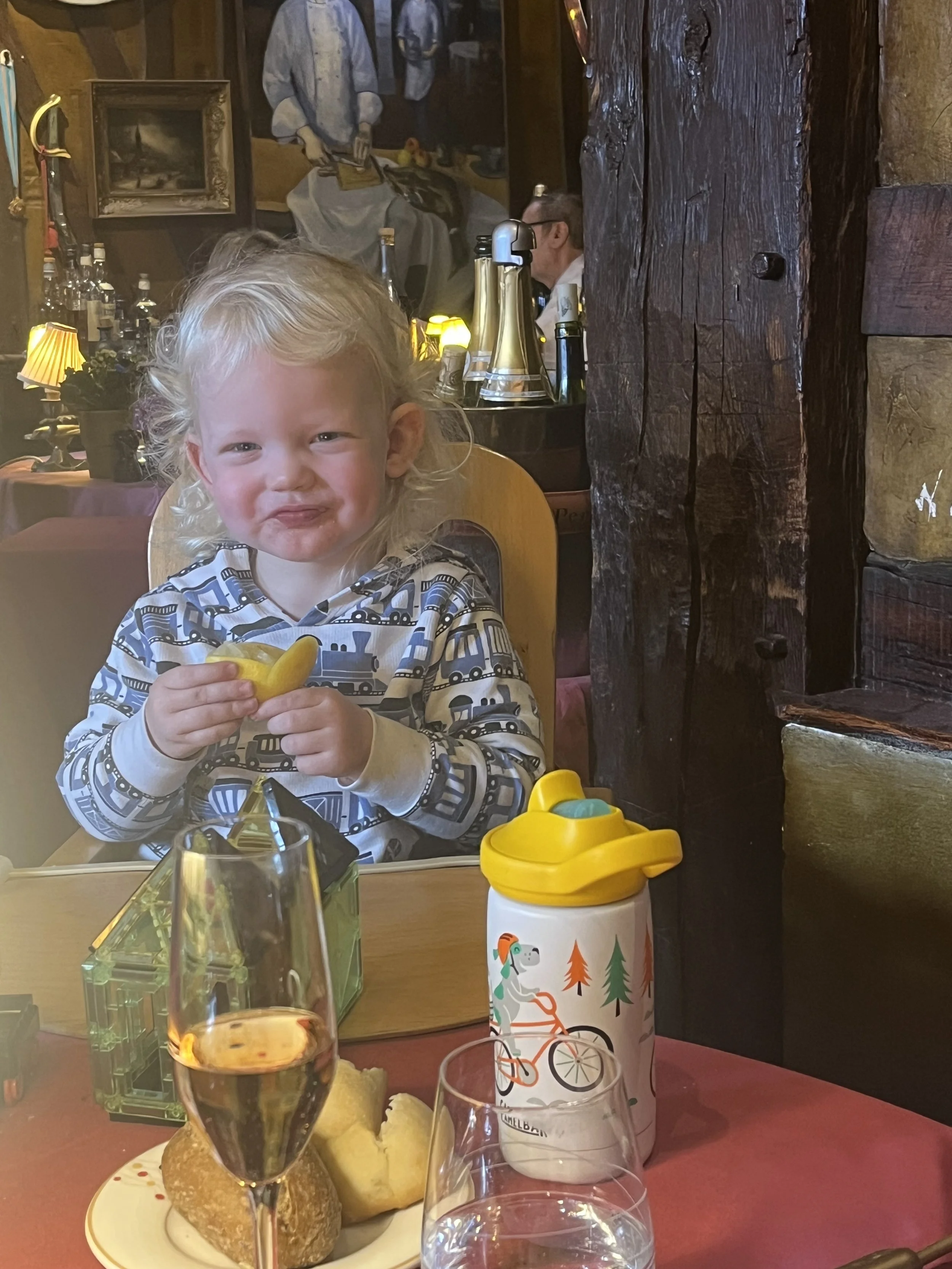
We ate at La Couronne for lunch. While they offered canard au sang, neither of us had enough appetite to handle it—it’s a lot of food. Fortunately for us, another couple in the dining room ordered it and we were able to watch its preparation. Instead, we ordered á la Julia: oysters, the sole meuniére for Katy, the cœur de filet du bœuf cooked á point with foie gras for me, and a millefeuille and espresso for dessert.

I didn’t have high expectations going into this meal. In fact, I expected to be let down. A restaurant like this could very easily skate on a mention in an autobiography by a world-renowned and beloved chef for decades and cater to tourists alone. It’s with a lot of joy that I say I wasn’t disappointed at all—quite the opposite. Everything was cooked incredibly well, the service was top-notch. It was the kind of meal that celebrates the French idea of lunch: take your time, eat well, enjoy yourself and one another.
For being just over two years old, Auggie is an absolute champ during these two-to-three hour meals. While he’s not always eating along with us, he is playing with his “house” (Magnatiles) and a train that one of my classmates got for him. His chorus is “train coming, Daddy! Train coming!”
While Auggie’s interest in firetrucks and trains hasn’t wavered, he has a new focus taking shape. All of his favorite things are “BIG” things, including but not limited to BIG bites of food, BIG diapers, BIG buses, and BIG slides. He’ll often look at something and say “Daddy, I want that! A BIG one!” Granted, the child himself is huge, so it only makes sense that he likes Auggie-sized things. Here in Rouen, there’s a monument called Le Gros Horloge. This translates to, you guessed it, “The Big Clock.” It’s a very large clock that has been operating since the 1300s. Upon seeing it, Auggie pointed up and said, “Daddy! BIG tick-tock!”
We’re beginning to think about potty training. This doesn’t stem from Auggie’s interest in using the potty, but rather from some conversations we’re having. When he gets that thousand-yard stare and starts to turn beet-red, we ask him if he’s pooping. He often responds with, “No, just toots.” And he’s usually telling the truth. The problem is that now he uses this as a catch-all response. “Auggie, would you like to wear your hat?” No, just toots. “Auggie, do you want to go to the park?” No, just toots. “Auggie, are you hungry?” No, just toots. You can probably imagine that when it’s finally not just toots, he assures us of how “big” it is, too.
Katy has started running, of all things. I haven’t even run since we’ve been here, and she’s out trotting to the Île aux Cygnes multiple times a week and doing laps. This weekend, she’s attending an in-apartment baking class with some other ex-pat women, where she will no doubt make lots of friends who will laugh at all of her jokes.
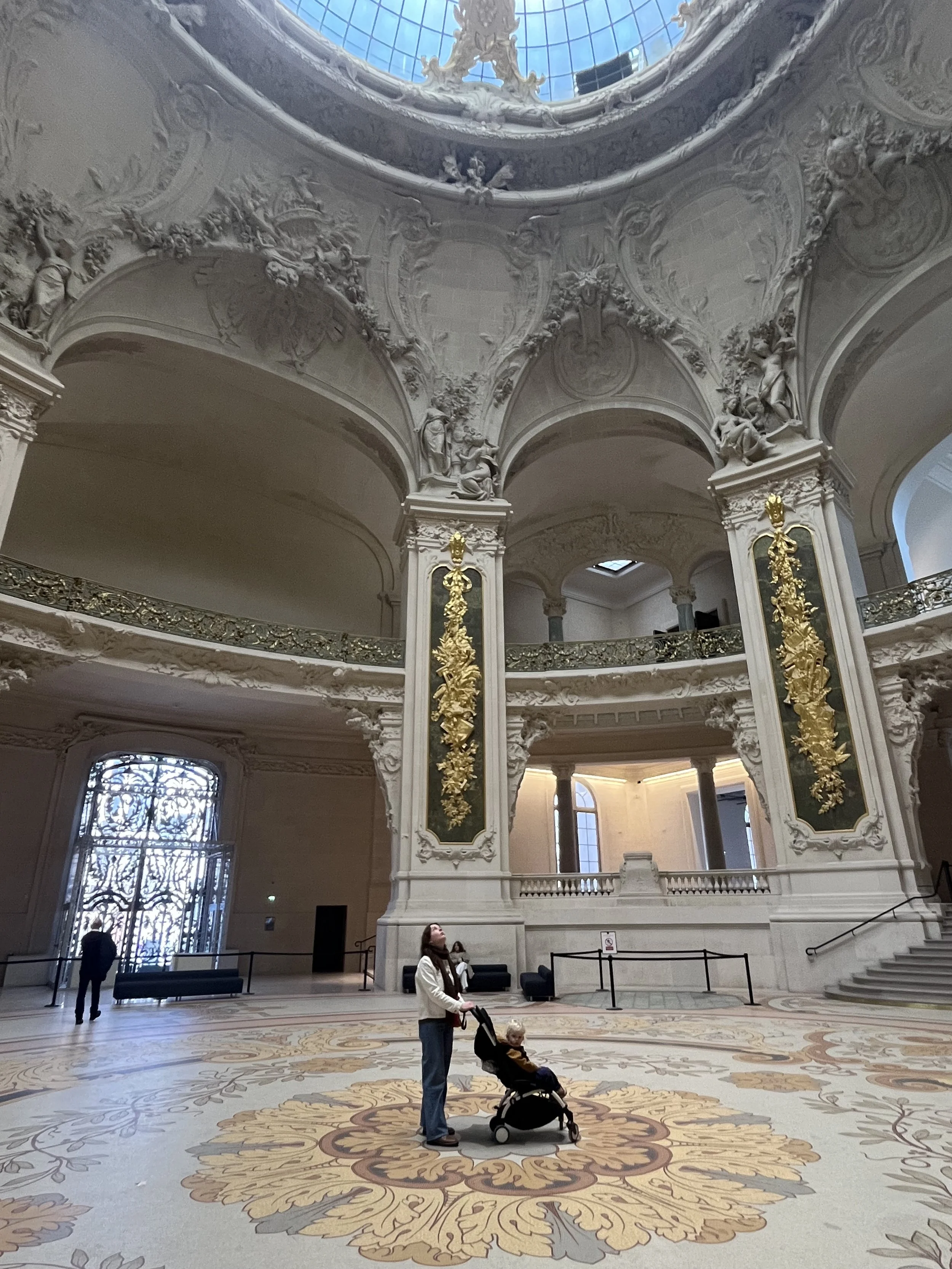
Recently our explorations of Paris led us, unexpectedly, into familiar territory. While on a search for a new book (in English, which limits my options significantly), we started to recognize our surroundings—a grocery store, some small shops, a couple of restaurants. Turning a corner, we were met by a grandiose wall of Eglise Saint Sulpice. This church is as tall as Notre Dame and larger overall—it’s the largest church in the city. More importantly, it’s across the street from the loft where we stayed the first time we came to Paris, with Harrison. We ate our first croissant and pain au chocolat in the square in front of the church, sitting on a bench. Wubs devoured that, and helped with a jambon beurre as well. I rolled him around in his stroller on those rocky sidewalks. One day, an older woman walked by and looked at Harrison, who was sleeping while I rocked him, and said, “Il est tres heureux,” he is very happy. While Katy, August and I stood there, memories flooded. Katy and I spent some time being sad, shedding some tears, and reliving very happy moments.
We didn’t mean to end up there. We were looking for a book. But I’m fairly certain Harrison led the way.
If you read my first newsletter, you might remember that one of my goals for learning at Le Cordon Bleu was fish cookery. Historically, I just haven’t been very good at it—either over- or under-cooking every filet I touched. In a twist of fate, all of my highest scores to date have come on fish dishes.
Things have been busy enough that my mind hasn’t had much chance to wander, but I did recently think of my dad. I am one of the quicker cooks in my class at butchery and fish cleaning. I know well how to remove a membrane and silver skin, and how to follow the line of bones when fileting a fish. The guts and gills don’t bother me. We only get about two hours to break down, prep, cook, and present a dish. Being fast at the first stage serves me well. And I’m quick at it because of Pop. He showed me countless times how to run my knife along a deer’s bones to best remove the steaks, how to feel the contours of the meat in the hams and let them guide you into the different cuts. I watched him filet hundreds of bluegill and crappie from southern Indiana lakes, gut and clean limit after limit of rainbow trout from the White River in Arkansas. If this part of the work comes easily to me, it’s because of that man. I’d like to be able to tell him that. Thanks, Pop.
We’re more than halfway through Basic Cuisine, already. Our final exam is approaching quickly. As of this writing, we have only eight more dishes to cook before it’s time to earn our first certificate. If you need me, I’ll be cutting potatoes and carrots into impossibly small, frustratingly even pieces.
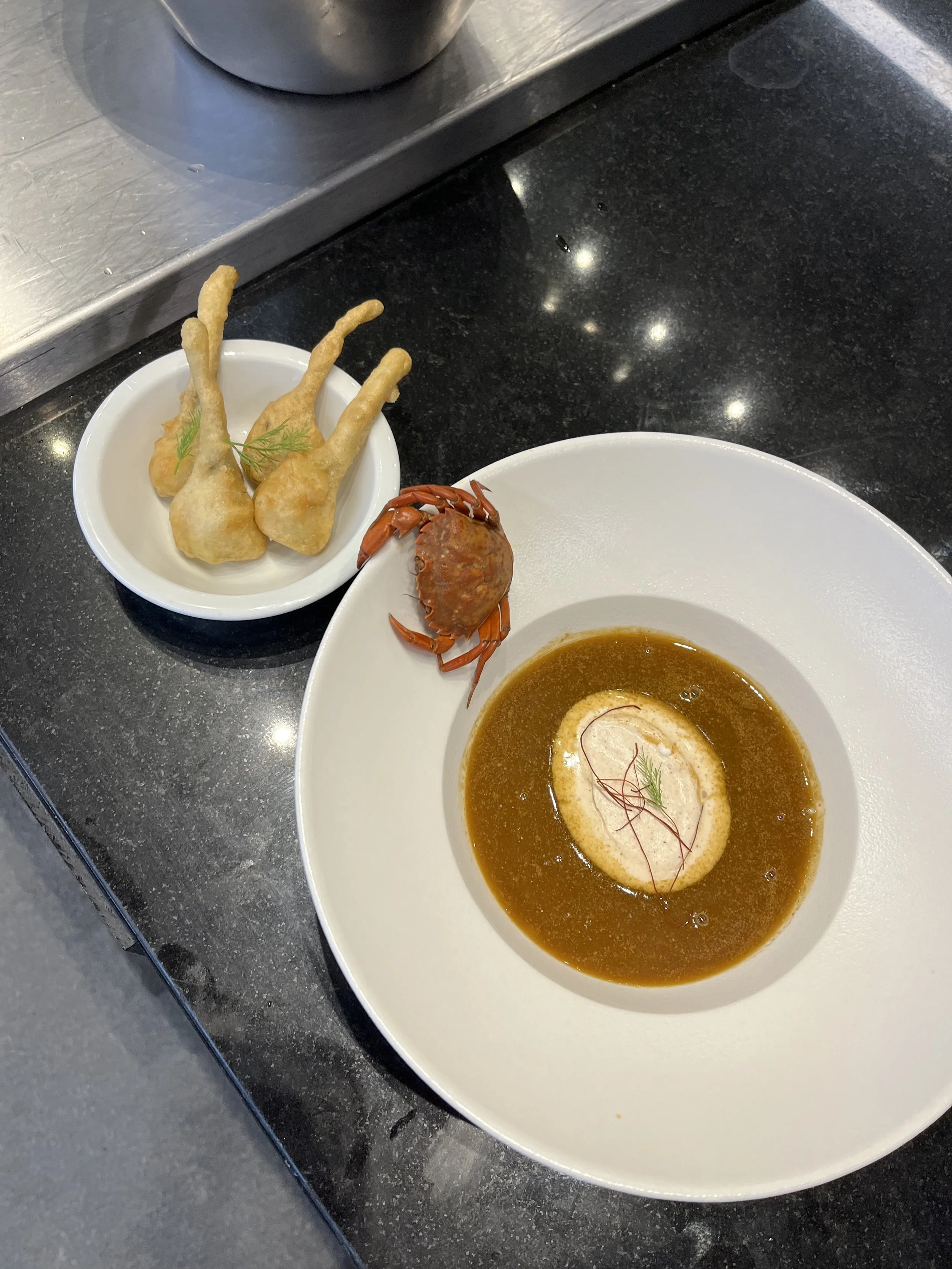
In one of our first classes, in which we learned the basics of what we need to know in order to attend—and succeed—at LCB, our chef enseigneur encouraged us to trust le processus (the process). I have relied on the creative process for as long as I can remember. To those unfamiliar, the creative process looks a lot like chaos. But it’s my chaos. Out of which usually comes something halfway palatable, which is then refined. I am a big believer in the process. In a recent one-on-one with the same chef to check in on how we’re feeling and doing, I mentioned that I could see my own improvement and I understand how and why the exercises are set up in the way they are. As much as I might want to sit through a class that’s about nothing but sauces, there’s only so much to be learned that way. Chef smiled and asked if I remembered what he said on our first day. I did. I do. And I am happy to trust it.